

Pine flooring is a softwood with a Janka hardness around 870 lbf, while oak scores 1,290 lbf (red) or 1,360 lbf (white). Oak resists dents and scratches better, making it ideal for busy spaces. Pine costs less upfront but needs more maintenance. Your best choice depends on your budget, lifestyle, and traffic levels.
You’re standing in a flooring showroom, trying to decide between pine and oak. Both look beautiful. Both come with strong opinions from every contractor you’ve talked to. And both sit in a price range that, honestly, feels less straightforward than you expected.
Here’s the thing — neither floor is a bad choice. But they’re built for different lives, different homes, and different budgets. This guide breaks down everything you need to know so you can walk out of that showroom with confidence.
What Makes Pine and Oak Different in the First Place?
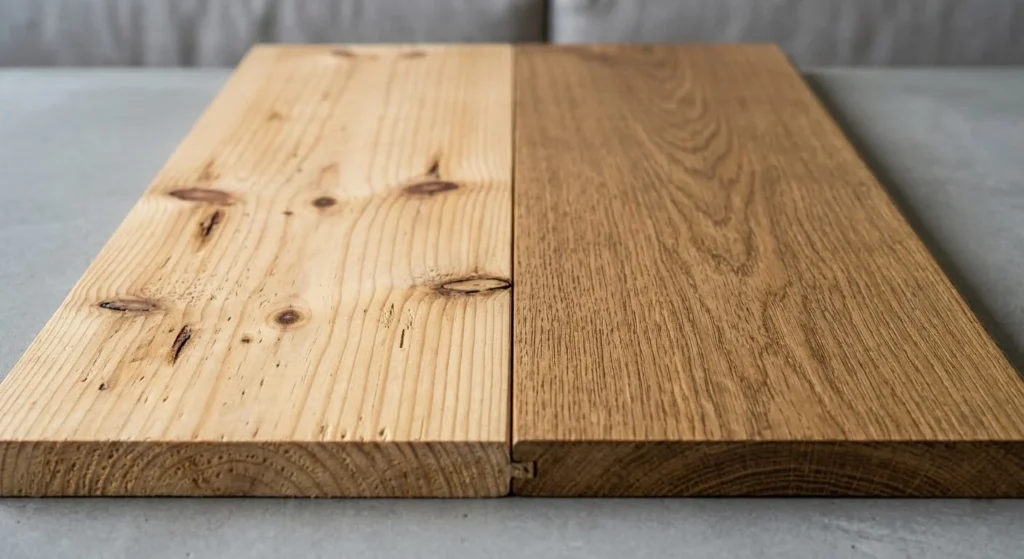
The single biggest difference between these two woods is hardness. Oak is a hardwood, and pine is a softwood. That’s not a quality judgment — it’s a biological one. Oak comes from slow-growing deciduous trees, which gives the wood time to become dense and strong. Pine grows much faster, which keeps its structure lighter and more pliable.
Wood hardness gets measured on the Janka scale. Red oak scores around 1,290 lbf (pound-force), and white oak comes in even higher at about 1,360 lbf. Pine, depending on the type, ranges from about 380 lbf for knotty pine to around 1,225 lbf for heart pine — a reclaimed, older variety that’s significantly denser than standard pine.
What does that mean for your floors? Harder wood resists dents and scratches from daily foot traffic, furniture legs, and the occasional dropped pan. The gap between standard pine and oak is significant enough that you’ll notice it over time, especially in high-traffic areas.
How Does Each Floor Hold Up Over Time?
Oak holds up exceptionally well. It handles foot traffic, resists moisture better than pine, and tends not to warp or buckle as seasons change. Unlike pine flooring, which can be prone to warping and buckling over time, oak is a weighty wood and less likely to move — which means less chance of damage or scratching.
Pine is more vulnerable to dents and wear, particularly in areas with heavy daily use. Drop a cast iron skillet, drag a chair across it, or let a large dog sprint across the room, and you’ll see the evidence. Deeper wear also happens faster on pine, so it’s best to avoid pine in heavy traffic areas like an entryway or a child’s room, or under furniture that can dent and scratch floors.
That said, pine isn’t fragile. In a bedroom, a study, or under a rug, it performs just fine. And there’s a camp of homeowners who actually love the way pine develops character over time — the dents and scuffs tell a story rather than ruin the floor. If you’re after that lived-in, rustic look, pine’s natural aging process can work in your favor.
Heart pine is worth a special mention. Harvested from the heartwood of older pine trees, it is denser and more durable than standard pine, making it far more competitive with oak on the durability scale. The catch is that most heart pine available today is reclaimed from old buildings, which makes it harder to source and more expensive.
What Does Each Floor Actually Cost?
This is where things get genuinely interesting — and where a lot of homeowners get surprised. On average, pine flooring costs range from $2 to $4 per square foot, while oak costs $4 to $7 per square foot. At first glance, pine looks like the obvious budget pick.
But the full picture is more complicated. The cheapest unfinished yellow pine is actually more expensive than most unfinished red oak in comparable widths when you compare real retail prices. That’s a surprise worth sitting with.
There’s also the long-term cost to factor in. Pine, being softer, needs refinishing more often than oak. Pine costs about 35% more to refinish than oak, as softer woods require a more time-consuming and careful process. So even if you save money upfront, you may spend more over the life of the floor.
Oak tends to be the better long-term investment. It lasts longer between refinishes, resists wear more effectively, and — when well-maintained — can last for generations without losing its appeal. Many real estate professionals will tell you that oak floors also add more resale value to a home than pine.
How Do They Look? Appearance and Style Compared
Both woods bring genuine warmth to a room, but they have distinct personalities.
Oak features a bold, defined grain pattern with visible lines running through each plank. Red oak leans warm with reddish-brown tones, while white oak has a more neutral, slightly grey-toned look. Stained oak boldens the natural grain, giving it more character and an enhanced texture, and different stains can completely transform the overall coloring. That versatility makes oak a popular choice for both traditional and contemporary interiors.
Pine starts out pale — a light yellowish-white color — and darkens naturally over time as it’s exposed to light and air. Pine flooring typically features prominent knots and grains, contributing to its rustic charm. Pine starts as a light, yellowish hue and darkens over time, developing a rich, amber patina.
If your home leans farmhouse, cottage, cabin, or rustic, pine fits beautifully. If you want something that works across a wider range of styles — modern, transitional, traditional — oak gives you more flexibility. Knotty pine is one specific variety worth noting; it has a distinct orange color and highly visible knots that make it a strong design statement. You either love it or you don’t.
Maintenance: What Are You Really Signing Up For?
Oak is genuinely low-maintenance once it’s installed and sealed. Oak flooring doesn’t require as much regular cleaning and maintenance as pine — a simple sweep and mop will keep oak floors looking beautiful for years.
Pine needs more attention. Because it’s softer, the surface finish wears down faster and needs to be reapplied more regularly. To maximize the lifespan of your pine, be sure to treat and seal it properly. Oak, on the other hand, is naturally resistant against moisture damage so fewer treatments are needed compared to pine.
For a busy household — especially one with kids, pets, or lots of foot traffic — the ongoing maintenance commitment for pine is worth thinking through carefully. You’ll need to stay on top of resealing, address scratches before moisture gets in, and refinish more frequently than you would with oak.
Which Rooms Work Best for Each?
Room choice matters a lot when you’re deciding between these two woods.
Oak works well in almost any room of the house. It handles the high traffic of hallways, living rooms, and kitchens without complaint. Its moisture resistance also makes it a reasonable option for kitchens, though you’ll still want to wipe up spills quickly with any wood floor.
Pine is better suited to lower-traffic spaces. Bedrooms, home offices, studies, and areas under rugs are where pine performs at its best. Pine is quite soft underfoot, providing a comfortable flooring option that can also insulate against cold, making it ideal for colder climates. This can contribute to a warmer indoor environment and potentially lower heating costs.
Pine also absorbs sound better than many harder floors, which can make a bedroom or living area feel noticeably quieter. That’s a small bonus that’s easy to overlook but genuinely pleasant to live with.
Sustainability: Which Wood Is the Greener Choice?
If environmental impact matters to your decision, pine has a real advantage here. Pine trees grow relatively quickly compared to hardwoods. Fast-growing trees like pines can be harvested within 25–30 years of planting, which is significantly shorter than the growth cycle for many hardwood species.
Oak takes far longer to mature, which makes it a slower resource to replenish. That said, responsibly sourced oak — look for FSC certification — ensures the wood was harvested without contributing to deforestation. Both options can be eco-friendly choices when you shop with sourcing in mind.
So Which Floor Should You Choose?
If you want a floor that handles daily punishment, requires less ongoing work, and holds its value over time, oak is the stronger pick. It costs more upfront, but it earns that price through longevity and versatility.
If you’re working with a tighter budget, decorating a lower-traffic room, or intentionally chasing a rustic, character-driven aesthetic, pine delivers genuine charm at a lower entry price. Just go in knowing it needs more care and is better kept away from your busiest spaces.
There’s no wrong answer here. The right floor is the one that fits how you actually live — and now you have everything you need to make that call.