
An open house sign is often the first thing a buyer sees — long before they step through the front door or meet the agent. Done well, it turns passing drivers into visitors. Done badly, it gets ignored, misread, or removed by a homeowners association. This guide covers everything you need to know in 2026: the types of signs, what to write on them, where to place them, the rules to check first, and the design mistakes that cost you visitors.
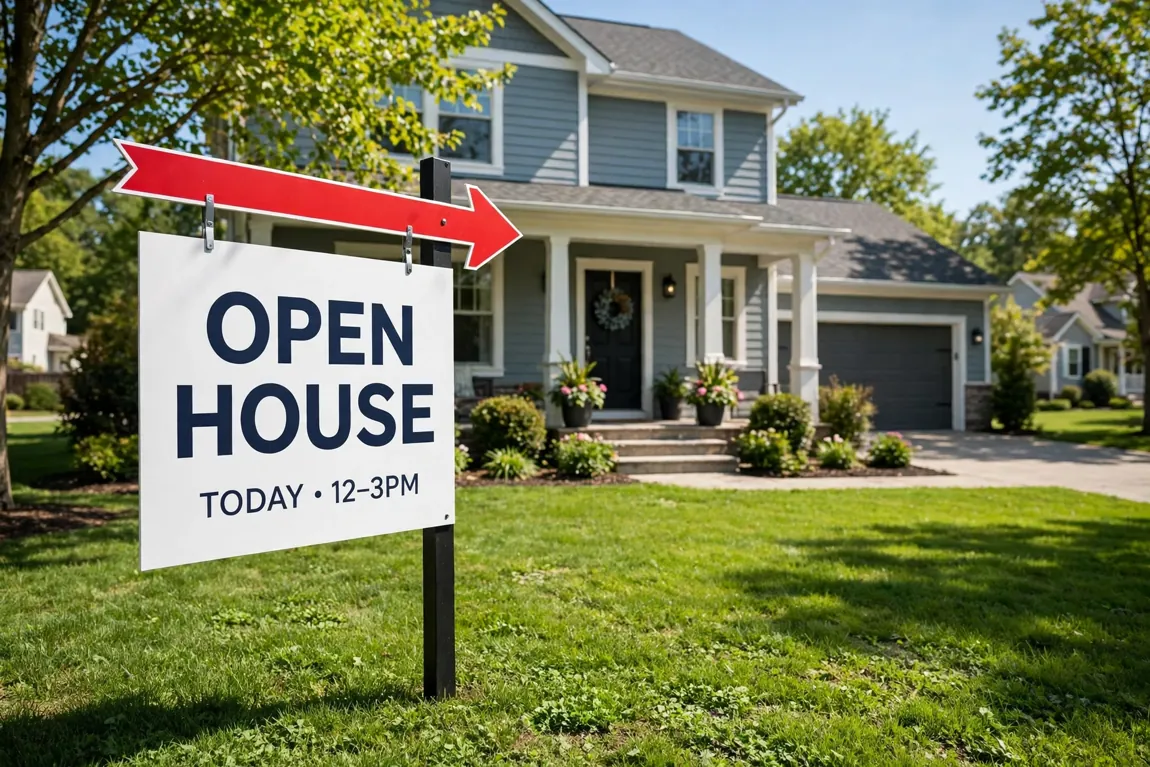
A clear yard sign with a bold arrow rider is still the most reliable way to guide buyers to the front door.
Why an Open House Sign Still Matters in 2026
Online listings do most of the heavy lifting, but they cannot catch someone driving through a neighborhood they already like. A well-placed sign reaches local buyers, curious neighbors, and weekend house hunters who had not planned to stop.
Think of signs as a trail: one at the house says you have arrived, while signs along the route show how to get there.
Types of Open House Signs
Most successful open houses use a combination of signs, rather than relying on a single sign in the front yard.
Yard Signs
The classic yard sign sits in front of the property on a frame or post, confirming the address and showing agent or brokerage branding. Plastic is affordable and weather-resistant; aluminum looks more polished and lasts longer. If you buy one sign, make it this one.
Riders
Riders are small panels above or below the main sign, saying “Open House,” “Today,” or showing an arrow. They turn a “For Sale” sign into an event sign in seconds. Keep rider text to one or two words.
Directional and Arrow Signs
Directional signs guide buyers from main roads to the property. They are smaller and simpler, with one job: pointing the right way. Match your main sign’s colors and branding so drivers recognize the trail.
A-Frame Signs
A-frame signs stand near the entrance and catch foot traffic from both directions. They suit details that do not fit on a yard sign: hours, a highlight like “4 bed, 2 bath,” or a QR code.
Banners and Flags
Banners suit a porch or fence, while feather flags add height and movement drivers notice from farther away. Both work best as supporting signs at the property, since they are harder to read from a moving car.
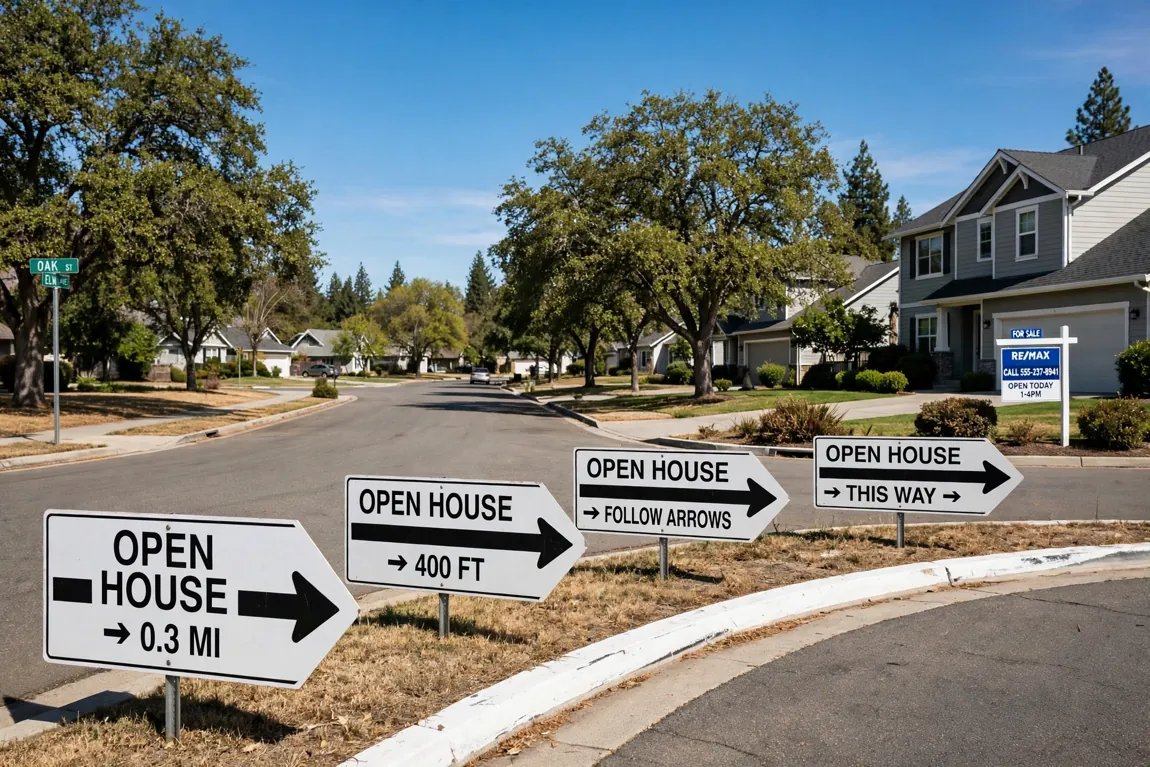
Directional signs at intersections turn passing traffic into visitors — place one at every turn on the route.
What to Write on an Open House Sign
A driver has about three seconds to read your sign, so every word must earn its place. At a minimum, include:
- Open House — the two words that matter most, in the largest type on the sign.
- Date and time — for example, “Sat, 12–3 PM.” A sign without hours leaves visitors guessing.
- Address or street name — especially helpful on directional signs, where drivers are still finding their way.
- Agent name and phone number — or brokerage branding, so serious buyers can follow up.
- One highlight, at most — such as “Newly Renovated.” More than that becomes clutter.
Skip the fine print. Square footage and full descriptions belong on the listing page, not on a sign viewed at 30 miles per hour. For more detail at the curb, add a QR code instead of shrinking your font.
Open House Sign Placement Strategy
Placement is where most open houses win or lose visitors. Plan the route a stranger would drive, then drive it yourself before the event.
- Start at the nearest main road, where traffic is heaviest.
- Mark every turn. A guessing driver is a lost visitor.
- Keep signs visible — not behind cars, hedges, or mailboxes.
- Give lead time: 100–200 feet before a turn on residential streets, more on faster roads.
- Face the traffic and check signs from inside a car.
- End at the property with a yard sign and A-frame showing where to park and enter.
Pick signs up promptly after the event. Forgotten signs look unprofessional and can draw a fine in many areas.
Local Rules, HOA Rules, and Sign Regulations to Check
Before you put a sign in the ground, check the rules for that street. Regulations vary widely, and a removed sign is no defense.
- City ordinances: Many limit size, height, number of signs, and how long they can stay up.
- HOA rules: Associations often restrict size, color, placement, and off-site signs. Get permission in writing if unsure.
- Public right-of-way: Sidewalks, medians, and utility poles are often off-limits.
- Private property: Never place a sign on a neighbor’s lawn or a business lot without the owner’s permission.
- State and brokerage rules: Some require disclosures or license numbers. Ask your broker.
When in doubt, call the city or HOA before the event, not after a sign is confiscated.
Digital and QR Code Options
A QR code links a roadside sign to the full listing: photos, a virtual tour, or a sign-in form. It is especially useful for buyers who drive past after hours.
Print the code large (at least two inches square on an A-frame) and test it with more than one phone before the event. Link it to a mobile-friendly page, and include a phone number beside it for people who will not scan. For showing prep, see our affordable decor refresh ideas and decluttering tips.
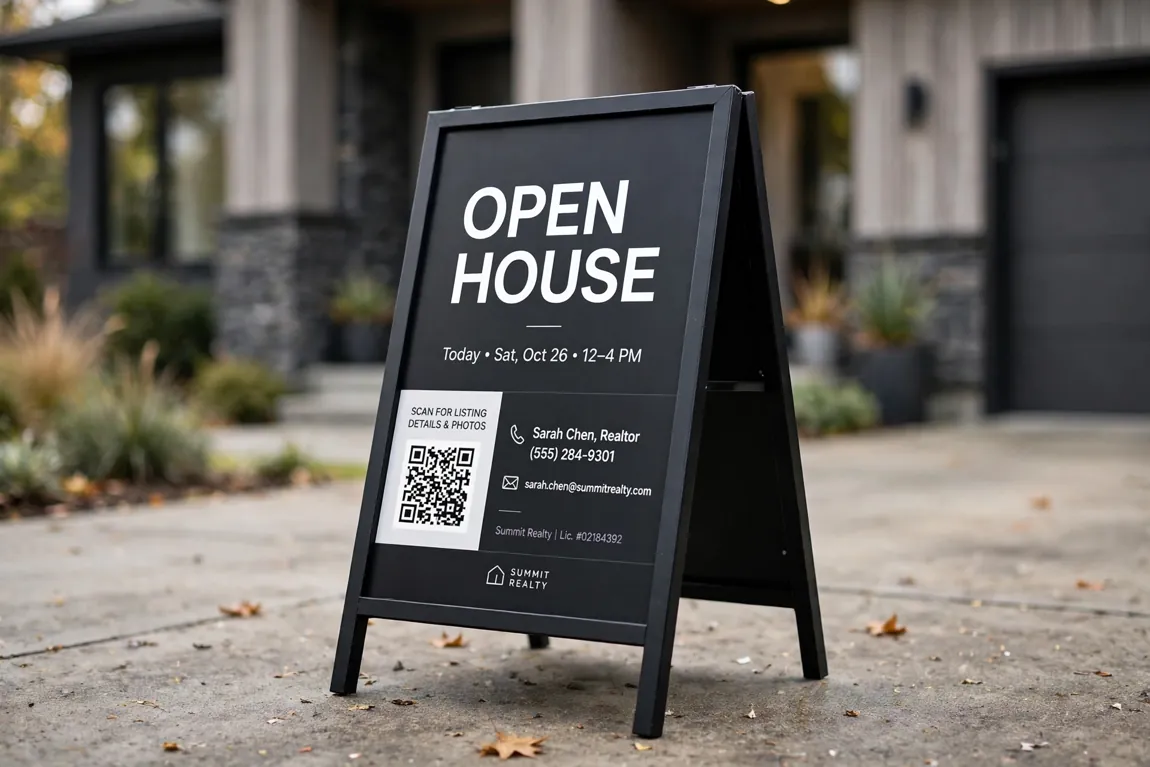
An A-frame near the entrance is the best place for a QR code — visitors are on foot and close enough to scan it.
Design Tips: Colors, Fonts, and Readability From a Car
A good open house sign is not about being fancy — it is about being readable at speed, in sunlight, from a car.
- High contrast wins: dark text on light, or white on dark.
- One bold font: clean sans-serif. Script and thin lettering disappear at a distance.
- Size for the street, not the desk: test readability from a driveway away.
- Two colors plus black or white, consistent across all signs.
- Leave empty space. White space around “Open House” makes those two words pop.
- Weatherproof everything and weigh down A-frames and flags.
Open House Sign Mistakes to Avoid
Most open house sign problems are predictable, and easy to prevent:
- Too much text. If drivers cannot grasp it in three seconds, they will drive past.
- Wrong or missing hours. A sign with no date or time invites visitors on the wrong day — or none at all.
- Inconsistent branding. If directional signs look nothing like the yard sign, drivers will not connect them into one route.
- Signs facing the wrong way. Check each sign from the driver’s perspective, especially at intersections.
- Ignoring the rules. A removed sign breaks the trail and can lead to a fine or a complaint.
- Leaving signs up after the event. Stale signs confuse future buyers. Collect them the same day.
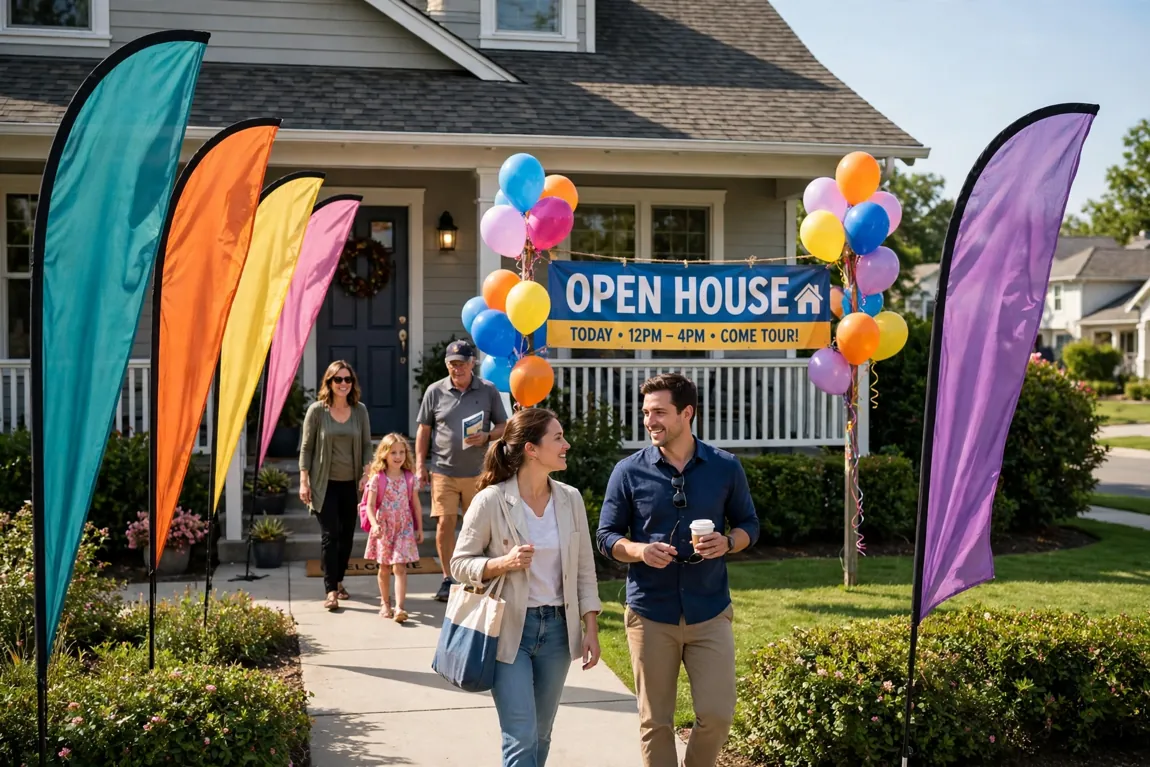
Flags and banners add visibility at the property itself — use them to complement, not replace, your directional signs.
Frequently Asked Questions
How many signs do I need for an open house?
Plan on one yard sign, one A-frame at the entrance, and one directional sign at each turn — usually three to six in total.
Can I put open house signs on public property?
Usually not. Medians, sidewalks, and utility poles are often off-limits — check city and HOA rules first.
What size should an open house sign be?
A standard yard sign is about 18 by 24 inches; A-frames are commonly 24 by 36 inches. Check local limits before ordering.
Are QR codes worth adding?
Yes, on A-frames where visitors are on foot. On roadside signs, keep it to an arrow and “Open House.”
Final Checklist Before Open House Day
Check this list the day before: route driven, date and address correct, HOA and city rules confirmed, QR codes tested, signs angled toward traffic, and a pickup plan after the event. If the property came through an inheritance, our inherited house in Fresno guide covers the selling decisions that come with it. Get the signs right, and more of the right buyers will walk through the door.