

To mow a lawn correctly, set your mower blade to 3–3.5 inches, never cut more than one-third of the grass blade at once, and mow in the early evening when the lawn is dry. Change your mowing pattern weekly, keep blades sharp, and leave clippings on the grass to feed the soil naturally.
Mowing the lawn sounds simple enough — you push a machine back and forth, the grass gets shorter, and you’re done. But there’s a lot more going on than that. The way you mow your lawn directly affects how healthy, green, and thick your grass grows all season long. Get it right, and your lawn practically takes care of itself. Get it wrong, and you’ll spend weeks trying to fix bare patches, yellowing tips, and stubborn weeds.
This guide walks you through everything you need to know about mowing a lawn properly — from prep work and blade height to the best time of day and what to do with all those clippings.
Prepare Your Lawn Before You Start the Engine
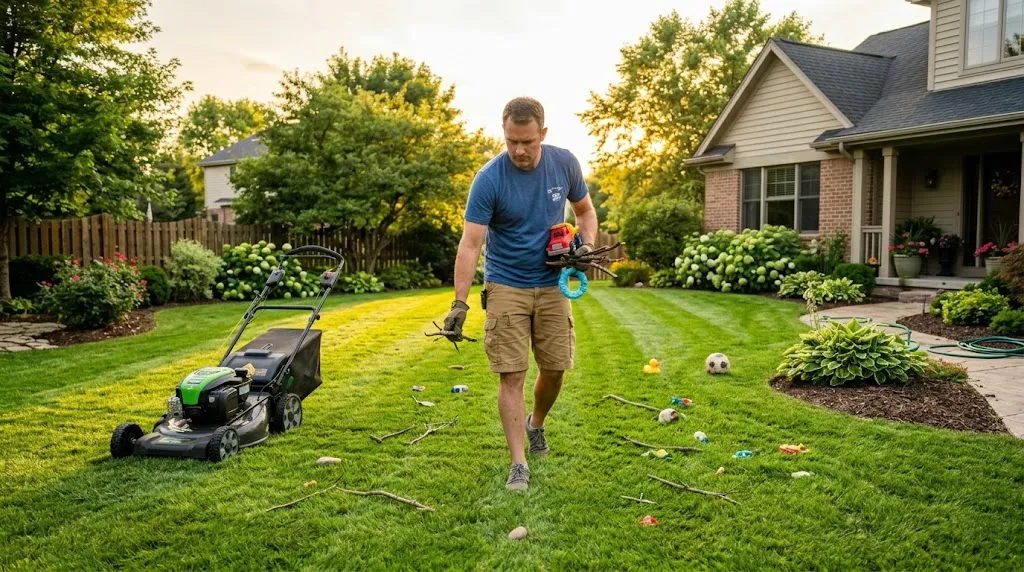
Before you even pull the mower out of the garage, do a quick walk of your yard. Pick up anything that might get caught in the mower blades or fly out of the discharge chute at up to 200 mph — breaking a window or injuring someone nearby. This includes rocks, sticks, kids’ toys, and anything else sitting in the grass.
While you’re walking around, mark any pipes, stumps, or objects sticking up above ground so you don’t run into them accidentally. Running over a gas pipe or hidden sprinkler head can cause a lot of damage — and cost you a lot of money.
This prep step takes about five minutes and can save you hours of headache later. It’s one of those habits that good lawn care people build into their routine without thinking twice.
Set Your Mower to the Right Cutting Height
One of the biggest mistakes homeowners make is cutting their grass too short. It might seem like a good idea — mow it low and you won’t have to mow again as soon. But it actually works against you.
A lawn should be mowed at a height of 3 inches or taller, with an ideal mowing height between 3 and 3.5 inches. Taller grass shades the soil underneath, which means less water evaporation and fewer weeds getting the sunlight they need to sprout. Longer blades also reduce evaporation, especially in the summer heat, and promote deeper roots that allow your grass to drink more water from the soil.
When a lawn is consistently mowed too short, the grass compensates by shortening its root system. A shorter root system means the grass requires more frequent watering and fertilization because grass blades with shorter roots can less readily absorb moisture and nutrients.
Set your mower to the highest setting before you start. Most modern mowers have a simple lever on the side of each wheel that adjusts the deck height. Check it before every session, since it can shift after hitting uneven ground.
Follow the One-Third Rule Every Single Time
Here’s the most important rule in lawn care: only cut the top one-third of the grass blades at any one time. Cutting more than that puts serious stress on the grass plant.
When you mow, you remove a portion of the leaf surface — the part that creates food for your grass through photosynthesis. Take off too much, and your lawn starts to starve. When you mow too short, the soil heats up, helping weed seeds to germinate.
This rule also tells you how often to mow. During spring, when grass grows fast, you might need to mow twice a week to keep up. When growth slows during the heat of summer or at the end of the growing season, your lawn may only need to be mowed once every week or two. The one-third rule beats any fixed schedule. Watch your grass, not the calendar.
Pick the Best Time of Day to Mow
Timing your mowing session matters more than most people realize. Mowing at the peak of day, when temperatures are highest, stresses both the lawn and the mower. It’s bad for the grass, and honestly, it’s pretty miserable for you too.
The best times to mow are in the morning after dew has dried on the grass or late in the evening when the sun isn’t so hot, giving the grass time to recuperate overnight before being exposed to the scorching sun and drying winds.
You also want to avoid mowing wet grass. Mowing wet grass makes it easier for lawn diseases to take hold. Your mower won’t cut as cleanly, and wet grass clippings can clog your mower and cause it to toss out clumps of wet grass. Wait until things dry out — a few hours after rain is usually enough.
Mow in the Right Pattern (and Switch It Up)
Most people mow their lawn in the same direction every single week. It’s easy, it’s familiar, and it’s actually hurting the grass. If you always cut your lawn using the same pattern, your grass learns which direction it’s being cut from and begins to lean in that direction.
By varying the mowing pattern, you help avoid forming ruts in the lawn, and grass will stand up nice and tall since it will be mowed from all different directions. Try going vertical one week, horizontal the next, then diagonal the week after that.
First, take two passes around the outside edges of your yard to give yourself room to turn the mower. Then work inward from there. Use the half-pass trick: every pass, overlap the area you’ve already mowed by half the width of your mower. This results in a smoother movement since there is less grass to cut in each pass, and you’ll catch anything missed the first time.
Keep Your Mower Blades Sharp
Sharp blades are the single biggest factor in how your lawn looks after a cut. Dull blades tear up grass, causing ragged, brown edges. Continuously using a dull mower blade can also cause your grass to weaken over time, making it more susceptible to disease, insect damage, and other stresses like heat and drought.
A sharp blade makes a clean, straight cut that heals quickly. A dull blade shreds the grass, leaving frayed tips that turn white or brown within a day or two. If you notice that happening after you mow, your blade needs attention.
Sharpening costs about $5–$15 per blade at a shop, while buying new blades typically runs $30–$40. Either way, it’s a small investment for a big difference in results. For average home use, sharpening once or twice a year is typically sufficient — at the start of the mowing season and again mid-season if needed.
What to Do With Grass Clippings
You have two choices after mowing: bag the clippings or leave them on the lawn. For most people, in most situations, leaving them is the better call.
Decomposed clippings add the equivalent of one fertilizer application to your lawn each year and improve soil quality while minimizing runoff. Clippings also break down quickly when you’re mowing often and following the one-third rule — you won’t even notice them.
That said, there are times to bag. Bag clippings when the lawn is very tall, when clippings are piling up, or if you see signs of disease. In those cases, removing clippings can improve appearance and reduce the spread of problems. Also bag if you’ve recently applied herbicide — don’t compost those clippings or use them as mulch.
Mow Safely Every Time
It sounds obvious, but lawn mowers are powerful machines that deserve real respect. Keep safety as your number one priority when mowing — you are dealing with many sharp blades and possible flying debris.
Always wear closed-toe shoes — never sandals or bare feet. Long pants protect your legs from debris. Eye protection is smart, especially on a windy day. Never allow children or pets to play near you when you’re mowing. A small stone can fly out of the discharge chute like a bullet.
When mowing on a slope, always mow across the slope, not up and down. If you’re using a riding mower, mow up and down the slope to prevent the mower from tipping over. And never, ever reach under a running mower to clear a blockage. Turn off the engine, wait for the blades to fully stop, then clear the jam.
How Often Should You Mow Your Lawn?
There’s no single answer — it depends on your grass type, the season, and how much rain you’ve had. Most lawns need mowing about once a week during active growth, but grass height matters more than the calendar. If the lawn is growing fast, you may need to mow more often to follow the one-third rule. As growth slows, you can extend the time between cuts.
Don’t skip mowing sessions to make life easier. Letting grass grow too long and then cutting it short in one pass creates more stress than regular mowing does. Stick to a flexible routine based on what the grass is telling you — and your lawn will reward you for it.
Final Thoughts on Mowing a Lawn the Right Way
Good mowing is about more than keeping things tidy. It directly shapes how deep your roots grow, how well your grass fights off disease, and how few weeds you deal with all season. The rules are simple: mow at the right height, never take off more than one-third at once, keep your blades sharp, change your pattern, and time your sessions well.
Start applying these habits this weekend, and you’ll see a real difference within a few weeks. A healthy lawn isn’t something that just happens — it’s something you build, one cut at a time.