

Ceiling fan sizing depends on your room’s square footage. Rooms under 75 sq ft need a 29–36 inch fan. Up to 144 sq ft needs 36–44 inches. Up to 225 sq ft works best with 44–52 inches. Rooms 225–400 sq ft need 52–60 inches. Anything larger needs 60+ inches or two fans.
You’ve probably stood in a store staring at a wall of ceiling fans and wondered — does size actually matter? It really does. Pick a fan that’s too small and your room stays warm no matter how fast it spins. Pick one that’s too big and it feels like you’re sitting under a helicopter. Getting the size right makes your home more comfortable and keeps your energy bill lower. This guide walks you through exactly how to do it, room by room.
Why Getting the Size Wrong Costs You Money
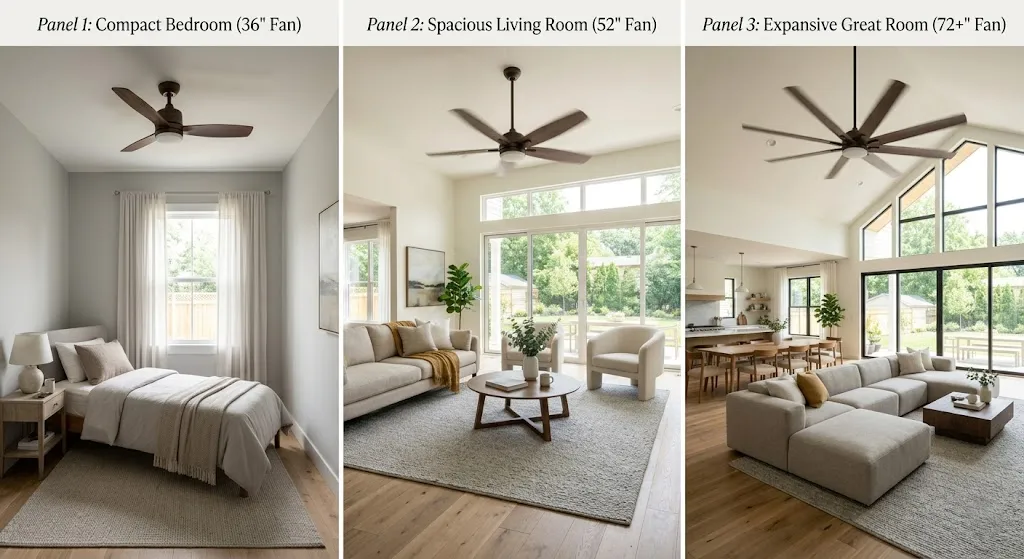
A ceiling fan that’s too small for your room has to spin at top speed just to move a decent amount of air. That puts stress on the motor, burns more electricity, and still doesn’t cool the room well. On the flip side, an oversized fan in a small bedroom creates an uncomfortable, drafty feel — and it looks out of place on the ceiling.
A fan that’s too small leaves warm pockets and has to spin at high speed, while an oversized unit can create a distracting draft and waste electricity. The good news is that sizing a ceiling fan is simple once you know two numbers: your room’s square footage and your ceiling height. Start with those two measurements and everything else falls into place.
Step One: Measure Your Room the Right Way

Before you do anything else, grab a tape measure. Measure from one wall to the opposite wall along the floor to get the length. Then measure the width the same way. Multiply length by width to get your square footage. A 12 x 15-foot room gives you 180 square feet.
If your room is an L-shape, don’t panic. Just divide the room into two separate rectangles, calculate the square footage of each one, and add them together. That total number is what you’ll use to find the right fan size. It takes about two minutes and saves you from making a costly mistake.
The Ceiling Fan Size Chart: Matching Room Size to Blade Span
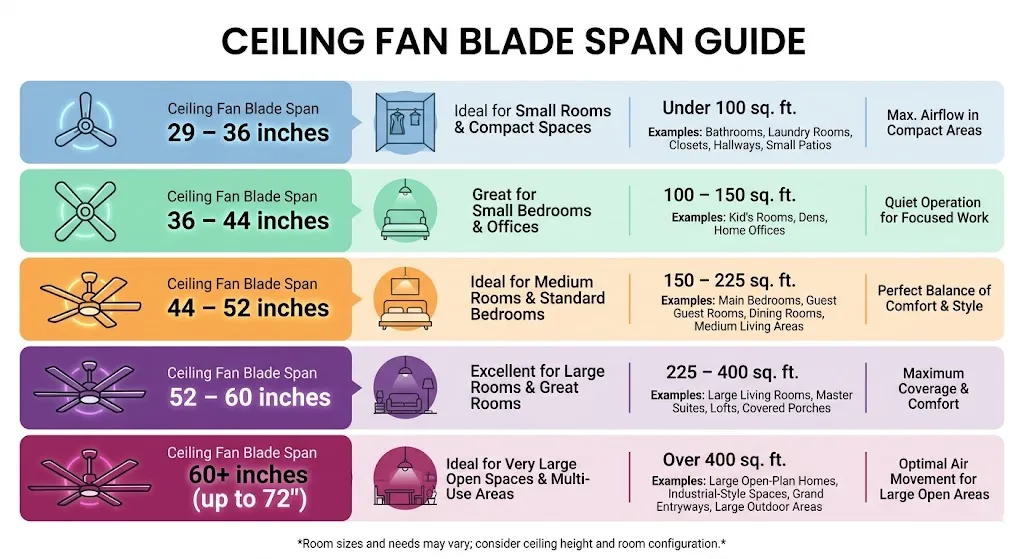
Blade span — also called sweep — is the tip-to-tip diameter of the fan blades. Ceiling fan size is measured by blade span, which is the distance from blade tip to blade tip across the width of the circle the blades make as they move. Every fan manufacturer uses this measurement, so once you know your target span, you can shop any brand confidently.
Here’s the standard sizing breakdown used across the industry.
For a room up to 75 square feet, a fan with a blade span of 29–36 inches works well. For rooms up to 144 square feet, go with 36–44 inches. For rooms up to 225 square feet, a 44-inch or larger fan is the right call. For standard bedrooms, dining rooms, and kitchens — which often fall between 150 and 300 square feet — a fan with a 44–52 inch blade span delivers good airflow without overpowering the space. For larger living rooms and open areas over 300 square feet, a 52–60 inch blade span is the better fit.
Massive spaces like great rooms, vaulted kitchens, and covered patios typically need something in the 60- to 96-inch range. If you’re dealing with a very large room, it’s often smarter to use two fans rather than one giant one. Two 52-inch fans in a 500 square foot room actually outperform a single 72-inch fan because the airflow reaches more of the space.
What Is CFM and Why It Matters as Much as Blade Span
Blade span tells you how big the fan is, but CFM tells you how hard it works. CFM stands for cubic feet per minute — the amount of air the fan moves every 60 seconds. CFM measures the number of cubic feet of air a fan moves in a minute, and it should always be considered when comparing fans. Fans with the same exact blade span can move very different amounts of air.
A higher CFM means stronger cooling, which is ideal for larger or warmer areas. For a regular bedroom of 144 to 225 square feet, you want a CFM rating somewhere between 1,600 and 4,500. For living rooms above 300 square feet, look for fans rated above 5,000 CFM. Always check the CFM rating on the product listing — don’t just assume a bigger fan moves more air, because motor quality and blade angle play just as large a role.
Blade pitch also matters. Steeper blades at 12 to 15 degrees move air more effectively. When two fans have the same blade span but different pitches, the one with the steeper angle almost always wins on airflow.
How Ceiling Height Changes Your Fan Choice
Room area gets you the blade span. Ceiling height determines how you mount the fan. These are two separate decisions, and skipping the second one is the most common mistake homeowners make.
Ceiling fans should be installed in the middle of the room and at least 7 feet above the floor and 18 inches from the walls. If ceiling height allows, install the fan 8 to 9 feet above the floor for the best airflow.
For rooms with ceilings at 8 feet or lower, a flush-mount fan — sometimes called a hugger fan — is your best option. These fans are ideal for 8-foot ceilings or smaller, especially when paired with a flush mount bracket. They sit close to the ceiling without a downrod, which keeps the blades safely above head height.
For higher ceilings, you need a downrod. The most common method for finding the right downrod length is to take the ceiling height, subtract the height of the ceiling fan — most fans are between 12 and 18 inches tall — and then subtract the desired hanging height of 8 feet. So if your ceiling is 10 feet high and your fan body is 12 inches, you need roughly a 12-inch downrod to land at the ideal height.
For ceilings higher than 9 feet, increase downrod length by 6 inches for every additional foot of ceiling height above 9 feet. This keeps the fan blades right in the sweet spot where they move the most air efficiently.
Vaulted and Sloped Ceilings Need Special Attention
Vaulted ceilings look stunning, but they create a real challenge for ceiling fan installation. A fan mounted flush against a steep slope will hang at an angle instead of level — and a fan that hangs crooked doesn’t just look bad, it wobbles, wears out faster, and moves air unevenly.
For ceilings with a slope greater than 30 degrees, you’ll need a sloped ceiling adapter kit. These kits ensure the fan hangs level despite the angled ceiling, which is critical for proper operation and preventing wobble.
Mounting a fan too high on a vaulted ceiling significantly reduces the cooling effect at floor level. Even on a vaulted ceiling, your goal is still to get the blades between 8 and 9 feet off the floor. Use the right adapter and a properly sized downrod to hit that target.
Outdoor and Large Open Spaces: Different Rules Apply
Outdoor fans work differently than indoor ones, and you can’t just move any fan outside. For outdoor or humid environments, choose fans with appropriate damp or wet ratings. Damp-rated fans can’t be directly exposed to weather, but wet-rated fans can be. Using a standard indoor fan on a covered porch will cause the motor to corrode and fail, sometimes within a single season.
For large open-concept living areas — think kitchens that open into dining rooms, or great rooms that run 400 square feet or more — a single fan rarely does the job. Multiple fans are especially useful in open-concept areas or rooms over 400 square feet. They improve air circulation and allow for more flexible design choices. Space two fans about evenly across the room so the airflow overlaps in the middle, covering every corner.
Safety Clearances You Can’t Ignore
Two clearance rules exist for every ceiling fan installation, regardless of the size or room type. First, the blades must stay at least 7 feet above the floor. You must keep at least 7 feet between fan blades and the floor to avoid any contact with spinning blades. Anything lower is a safety hazard, especially in homes with tall family members.
Second, keep adequate distance from the walls. Ensure a minimum of 18 inches between the blade tips and walls. This avoids airflow restrictions and wobble issues. When a blade tip gets too close to a wall, the fan can’t pull air freely across its full rotation. The result is reduced airflow, increased noise, and a fan that rocks slightly — none of which you want.
One Final Check Before You Buy
Once you’ve matched your blade span to your room’s square footage, confirmed the right mounting style for your ceiling height, and checked that the CFM fits your room’s needs, there’s one last thing to do — check the energy rating. DC motors use about 40% less electricity than AC motors. Spending a little more upfront on a DC motor fan pays off fast in monthly savings, especially if the fan runs most of the day.
Also remember that ceiling fans work in winter too. Run the fan slowly in reverse — clockwise — and it gently pushes the warm air that collects near the ceiling back down into the room. That small habit can shave a noticeable amount off your heating bill without any extra cost.
Pick the right size, mount it at the right height, and your ceiling fan will keep your home comfortable year-round.