

Penrose tiling is a way of covering a flat surface with shapes that never form a repeating pattern. Created by mathematician Roger Penrose in the 1970s, it uses just two tile shapes—like “kites and darts” or “fat and skinny rhombuses”—following specific matching rules. The result is endlessly unique, yet still has a sense of order and symmetry.
Have you ever looked at a floor pattern and felt like something about it was a little… off? Not in a bad way, but in a way that made you look twice? There’s a good chance you were looking at a Penrose tiling.
This guide walks you through what Penrose tiling actually is, how it works, where it came from, and why so many people in math, science, and design find it so interesting. No advanced math degree needed. We’ll keep things simple and clear, just like a friend explaining it over coffee.
What Is Penrose Tiling, Exactly?
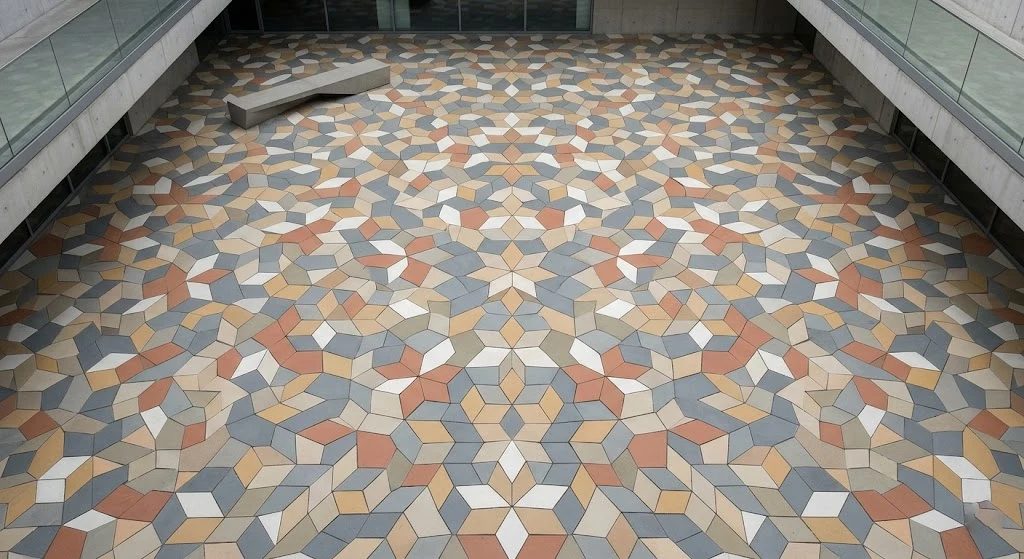
Penrose tiling is a pattern made from a small set of shapes that fit together to cover a flat surface, like a floor or a wall, with no gaps and no overlaps. So far, that sounds like any normal tile pattern, right?
Here’s the twist. Most tile patterns repeat. Think about a checkerboard or a typical kitchen floor. You could trace a small section, copy it, slide it over, and the whole pattern would line up again. That’s called a periodic pattern.
Penrose tiling is different because it’s a form of aperiodic pattern, meaning it doesn’t repeat itself. No matter how large the tiled area gets, you’ll never find a section that repeats exactly the same way across the whole surface.
It might sound like this would create a messy, random-looking pattern. But that’s not the case at all. Part of what makes Penrose tiling so beautiful is that it can have rotational symmetry and reflection symmetry, even though it lacks the repeating, sliding symmetry found in normal tile patterns. You can rotate certain Penrose patterns around a central point, and they’ll still look the same.
So you get a pattern that feels balanced and intentional, but never settles into a predictable rhythm. That contrast is exactly why people find it so visually interesting.
Who Came Up With Penrose Tiling?
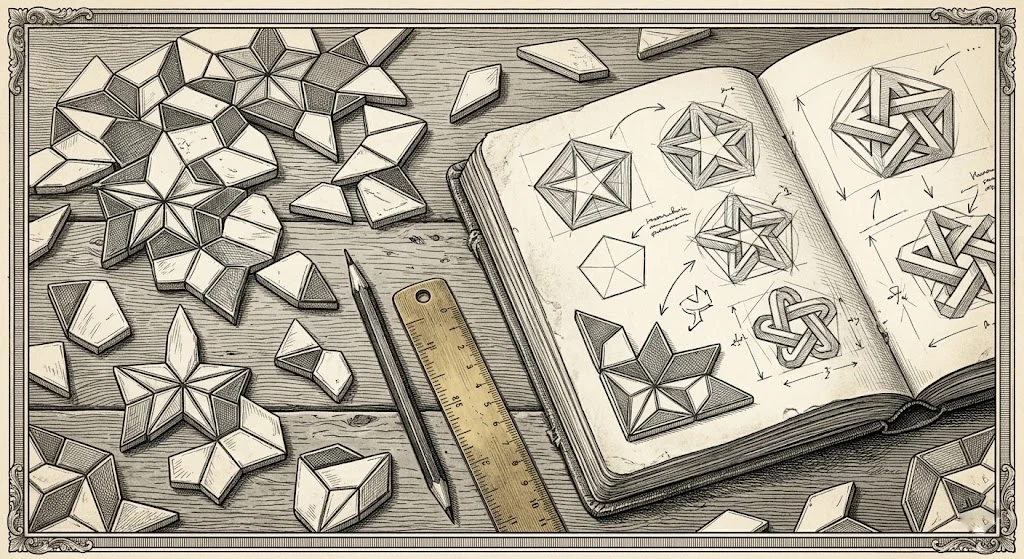
Penrose tiling is named after Roger Penrose, a mathematician and physicist who studied these patterns in the 1970s. He wasn’t the very first person to explore non-repeating tile patterns, though.
Back in 1966, a researcher named Robert Berger found the first known aperiodic set of tiles, but it required over 20,000 different tile shapes. That’s obviously not very practical. A few years later, Raphael Robinson managed to bring that number down to just six tiles.
Then Roger Penrose took things even further. Working through the geometry himself, he managed to create an aperiodic tiling using just two simple shapes, which mathematician John Conway later named “kites” and “darts”. Two shapes. That’s all it takes to create a pattern that never repeats across an infinite surface. It’s a pretty remarkable bit of math when you stop and think about it.
The Two Main Types of Penrose Tiles
There are a few different versions of Penrose tiling, but two sets of shapes come up most often.
The first set is the kite and dart. The kite is a four-sided shape with angles of 72, 72, 72, and 144 degrees. The dart is a non-convex shape with angles of 36, 72, 36, and 216 degrees. Picture a simple kite shape next to a little arrow-like notch, and you’re on the right track.
The second set is made of rhombuses, sometimes called the “fat” and “skinny” rhombs. The thin rhombus has corners of 36, 144, 36, and 144 degrees, while the thick rhombus has corners of 72, 108, 72, and 108 degrees.
Both sets share something important. In strict Penrose tiling, tiles have to be placed so that certain markings on their edges line up correctly. This rule stops the tiles from simply combining to form a basic rhombus, which would allow the pattern to repeat.
So the shapes alone aren’t the whole story. The rules about how they connect are just as important as the shapes themselves.
Why the Golden Ratio Keeps Showing Up
If you start looking into Penrose tiling, you’ll run into the golden ratio pretty quickly. This number, roughly 1.618, shows up all over nature, art, and architecture. It turns out it’s also baked right into Penrose tiles.
Both the kite and dart shapes are built using the golden section. The areas of the two main tile shapes are even in the golden ratio to each other.
Why does this matter? The golden ratio has a special mathematical property: it’s irrational, meaning it never settles into a neat fraction or a repeating decimal. That irrational quality plays a direct role in why these tilings end up aperiodic in the first place.
In a strange way, the same ratio that shows up in seashells, sunflowers, and famous paintings is also what helps create a pattern that mathematically refuses to repeat. That’s a pretty cool connection between art and math.
From Math Theory to Real Crystals
For a long time, Penrose tiling was seen as a fun, clever math puzzle. Interesting, sure, but mostly theoretical. Then something surprising happened in the world of materials science.
The 2011 Nobel Prize in Chemistry was awarded to Dan Shechtman for discovering quasicrystals, and Penrose’s earlier work was credited with helping researchers understand what he’d found.
Here’s the short version. Shechtman was studying a metal alloy and found that its atoms were arranged in patterns that looked just like the pentagons, rhombi, kites, and darts that Penrose had described years earlier. The problem was that, at the time, scientists believed this kind of atomic arrangement simply wasn’t possible.
For about 80 years, a crystal had been defined as something with an ordered, repeating structure, since every crystal anyone had ever studied followed that rule. Shechtman’s discovery didn’t fit that definition at all. It wasn’t until 1992 that crystallography’s governing body created a committee to rewrite the definition of what a crystal even is.
So a pattern that started as an abstract math idea ended up reshaping how scientists understand the building blocks of matter. Not bad for two simple shapes.
Where You’ll Spot Penrose Tiling in Real Life
Once you know what to look for, Penrose patterns start showing up in some unexpected places.
Architects and designers have used Penrose tiling in flooring and decoration. The pattern’s mix of order and unpredictability makes it a striking choice for public spaces, courtyards, and floors where people will spend time looking down.
There’s also a fun bit of trivia connected to the pattern’s popularity. In 1997, Penrose actually sued a toilet paper company over a quilted pattern that closely resembled his aperiodic tiling design. The case was settled outside of court, but it shows just how recognizable and distinctive this pattern had become by that point.
You’ll also find Penrose-inspired designs in quilts, mosaics, and digital art. Artists have created everything from Penrose mandalas to Penrose-tiled lace and embroidery patterns, proving this isn’t just something locked away in math textbooks.
How to Try Penrose Tiling Yourself
If this all sounds interesting, you might be wondering if you can actually make one of these patterns yourself. Good news: you can, and you don’t need to be a mathematician to start.
One common approach uses paper or cardboard rhombus shapes. You cut out a set of “fat” and “skinny” rhombus strips using printed guides, then arrange them according to the matching rules.
A helpful trick involves color-coding the edges of your tiles. You can mark each tile with colored arcs, then place tiles so that arcs of matching colors line up along shared edges. Following this color-matching rule helps guide you toward a valid aperiodic pattern, though you might occasionally hit a dead end and need to backtrack a bit.
For a more digital approach, several online tools and apps let you generate Penrose patterns automatically. These let you experiment with colors, scales, and starting points without cutting a single piece of paper. It’s a great way to get a feel for how the pattern grows before trying it by hand.
A Pattern Worth a Second Look
Penrose tiling sits in a strange and wonderful spot. It’s simple enough to build with paper and scissors, yet deep enough to help explain the structure of matter itself. It’s mathematically precise, yet visually full of life and movement.
Whether you’re drawn to the math side, the art side, or just like the idea of a pattern that goes on forever without repeating, Penrose tiling offers something genuinely worth exploring. Grab some paper, print out a few tile templates, and see what kind of pattern you can build. You might be surprised at what starts to take shape.