

AC systems don’t usually die without warning. They slow down first. They struggle on hot days. They run longer. They make sounds they didn’t used to make. By the time they stop working entirely, most of those signals had been showing up for months — sometimes years.
The problem is that none of these signs feel urgent until it’s 95 degrees and nothing is happening. At that point, you’re not making a calm financial decision about ac repair versus replacement. You’re making a distressed call on a Friday afternoon hoping someone can come out the same day.
These are the five signs that a Bay Area AC system is running on borrowed time — and what each one actually means.
Sign 1: The system runs longer but cools less
This is the most common early signal, and it gets dismissed more often than any other. The system sounds like it’s working — it’s on, it’s running, the air coming out feels somewhat cool — but the house never quite reaches the thermostat setting. Or it does, but it takes two hours on a day that used to take forty-five minutes.
What’s happening: The system is losing capacity. Causes range from a refrigerant leak (the system can’t transfer heat as efficiently) to a dirty or failing condenser coil to a compressor that’s worn past the point of full output. Sometimes it’s multiple things at once.
Why it matters: A system that runs twice as long to achieve the same result is using roughly twice the electricity. Your utility bills are already reflecting this, whether you’ve noticed or not. The underlying cause doesn’t self-correct.
Quick check: Compare your last three summers’ electricity bills for July and August. If your usage has climbed year over year without a change in habits, the system is the likely explanation.
Sign 2: Short cycling — the system turns on, runs briefly, then shuts off and repeats
A properly functioning AC system runs in cycles — typically 15 to 20 minutes at a time, achieving the setpoint, then shutting off. Short cycling is when the system turns on for a few minutes, shuts off before reaching temperature, then starts again almost immediately.
What’s happening: Short cycling is hard on the compressor because startup draws significantly more power than steady-state operation. Each start-stop cycle strains the capacitor and compressor. Common causes include a refrigerant issue, a failing thermostat, or an oversized system that was never sized correctly for the home.
The compressor matters here because it’s the most expensive component in the system. A capacitor replacement is a few hundred dollars. A compressor replacement runs into the thousands — and on a system that’s already 10 or 12 years old, the math on that repair often points toward replacement.
Sign 3: Sounds that weren’t there before
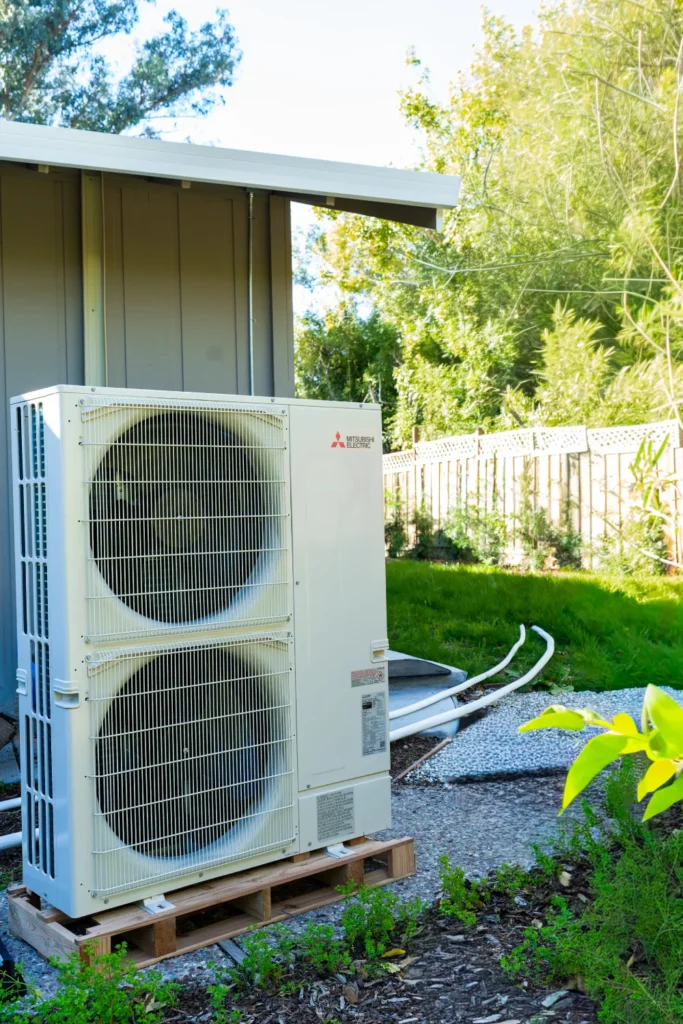
Rattling, grinding, squealing, or banging from the outdoor condenser or the indoor air handler are not normal operating sounds. An AC system that’s running correctly is relatively quiet.
- Rattling: loose components, debris inside the unit, or a failing fan blade
- Grinding: motor bearing failure — the motor is on its way out
- Squealing: belt or motor issues in older systems; a refrigerant hissing sound can indicate a leak
- Banging: a broken internal component moving around inside the unit
None of these get better on their own. Some — especially grinding — indicate a component that will fail completely and may damage adjacent parts when it does. A noise that starts in May becomes an emergency in July.
Sign 4: The system uses R-22 refrigerant
This one isn’t about performance — the system might still be cooling reasonably well. But if your AC was installed before roughly 2010, there’s a high probability it uses R-22, also known as Freon.
R-22 production was phased out in the U.S. in 2020. The refrigerant still exists in recycled and reclaimed supply, but that supply is finite and shrinking. The price has risen significantly — what used to be a routine recharge now runs well over $100 per pound, and some systems hold 6 to 15 pounds.
If your R-22 system develops a refrigerant leak, the repair cost calculation changes dramatically. You’re paying for increasingly scarce refrigerant on top of the actual repair. A leak that would have been a straightforward fix five years ago is now often a case where replacement makes more financial sense.
How to check: Look at the label on your outdoor condenser unit. It will list the refrigerant type. If it says R-22 or HCFC-22, you’re on an end-of-life refrigerant. If it says R-410A, you’re on the current generation — though R-410A is also beginning its own phasedown for new equipment.
Sign 5: You’ve repaired it more than once in the past two years
One repair on an aging system doesn’t tell you much. It might be a single component that failed — replace it and get several more years of useful life. Two or three repairs in a short window tells you something different.
Components in an HVAC system age together. When one part fails, the others have been running for the same number of hours under the same conditions. A capacitor that failed this year often means the contactor, the fan motor, and the compressor are all approaching end of life. You’re patching a system that’s degrading across the board.
There’s a useful rule of thumb in the industry: multiply the repair cost by the system’s age in years. If the result exceeds $5,000, the math typically favors replacement over repair. A $400 repair on a 15-year-old system gives you $6,000 — that’s a replacement conversation. The same $400 repair on a 6-year-old system gives you $2,400 — repair and move on.
The rule isn’t perfect. It doesn’t account for refrigerant type, the specific component that failed, or your home’s full replacement cost. But it’s a reasonable first filter before calling a technician.
Repair or Replace: A Quick Reference
Every situation is different, but here’s a general framework:
| Scenario | What it means | Typical call |
| System under 8 years, single issue | Repair almost always correct | Repair |
| System 8–12 years, one major repair | Run the $5,000 rule | Depends |
| System over 12 years, R-22 refrigerant | Replacement likely | Replace |
| System over 12 years, recurring repairs | Replacement likely | Replace |
| Compressor failure, system over 10 years | Replacement almost certain | Replace |
The $5,000 rule: multiply repair cost × system age in years. Over $5,000 generally favors replacement. Under $5,000 generally favors repair. Adjust based on refrigerant type and repair history.
One Thing Bay Area Homes Have Going for Them
The Bay Area climate is genuinely mild compared to most of California. Summers are warm, not brutal — the kind of heat that stresses an aging system but rarely kills it in a single day the way Phoenix or the Central Valley might. That means a system that’s struggling will often hold on through multiple summers before failing completely.
That’s both good and bad news. Good, because you usually have time to plan. Bad, because it creates a false sense of security. A system that limped through last summer is not necessarily going to limp through this one — especially if the marine layer is lighter and we get a stretch of genuine heat.
The right time to evaluate a system that’s showing these signs is in April or May, not July. You have options when it’s not urgent. When the system fails during a heat wave, your options narrow to whoever can come out fastest.
What to Do if You’re Seeing These Signs
If your system is showing one of these signs, it may be a repair. If it’s showing two or more, or if it’s over 12 years old, a replacement assessment is worth having before summer arrives.
A free estimate covers the system inspection, tells you what’s failing and why, and gives you a clear repair-vs-replace recommendation with actual numbers. You’re not committing to anything — you’re getting the information to make the right call before the heat makes it for you.
About the Author
Ozone Service is a licensed HVAC and electrical contractor serving San Jose, Sunnyvale, Santa Clara, Cupertino, Mountain View, and surrounding Bay Area communities. EPA 608 Certified, BBB Accredited. Free estimates include a full system assessment with a written repair-vs-replace recommendation.