

To safely inspect for cockroaches behind the refrigerator, unplug the unit, pull it out slowly, and use a flashlight. Look for live roaches, droppings, egg cases, and smear marks. Wear gloves, vacuum what you find, clean the area, seal gaps, and place baits or traps nearby.
You pull out a snack late at night, and something small dashes across the floor and vanishes under the fridge. Your stomach drops. You know where it went, and you know you need to look.
Cockroaches behind the refrigerator are one of the most common kitchen pest problems. The good news is that you can check the area yourself, and you can do it safely. This guide walks you through what to expect, what to wear, how to move the appliance, and what to do with what you find.
Why Cockroaches Choose the Space Behind Your Fridge
Most cockroach species come from warm, tropical places. They want heat, moisture, food, and a dark place to rest during the day. The back of your refrigerator offers all four.
The motor and compression system give off steady warmth. Many fridges also have a drip pan that collects water, and that water gives roaches something to drink. Crumbs, grease, and sticky spills slide under and behind the unit over the months. Nobody cleans there, so the food stays put.
The space is also tight. Cockroaches like to touch surfaces on both their backs and bellies, so narrow gaps feel safe to them. A fridge pushed against a wall leaves exactly that kind of gap. Add a few cracks in the wall or floor, and you have a quiet home that people rarely check.
The most likely culprit is the German cockroach. It is small, tan to light brown, and about half an inch long. It has two dark stripes behind its head. German roaches breed fast, and a single female can produce dozens of young from one egg case. American cockroaches, which are larger and reddish-brown, also visit now and then, especially in older homes or places with damp basements.
Signs You Have Cockroaches Behind the Refrigerator
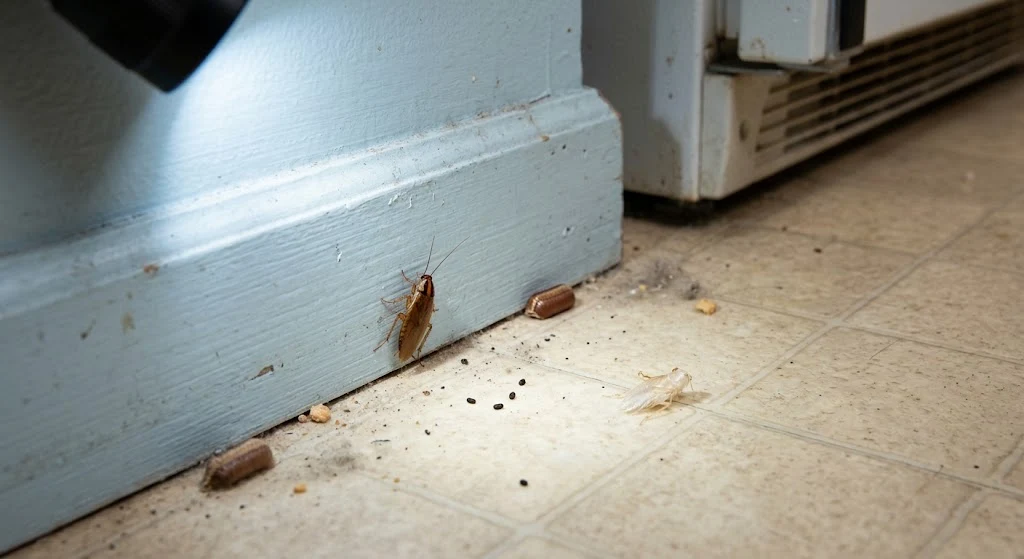
You may never see a live roach in the daytime. They hide when the lights are on and come out at night. So you need to look for clues.
Droppings are the most common sign. Small roaches leave tiny black specks that look like ground pepper or coffee grounds. Larger roaches leave bigger, cylinder-shaped droppings with ridges. You will often find them along the edges of the floor, near the wall, or around the motor housing.
Smear marks are another clue. In damp spots, roaches leave dark, irregular streaks. You may also notice a musty, oily smell that gets stronger when you open the cabinets near the fridge. Many people describe it as stale and sweet at the same time.
Egg cases, called oothecae, are the clearest warning. A German cockroach egg case is light brown, about the size of a grain of rice, and shaped like a tiny purse. The female carries it until the eggs are almost ready to hatch. American roaches glue their cases to surfaces, so you may find a dark brown one stuck to a wall or the back panel of the fridge.
You might also see shed skins. Young roaches shed their outer shell several times as they grow. These skins look like pale, papery copies of the insect. Finding a few of them means young roaches are growing up nearby.
If you spot even one roach in daylight, take it seriously. Roaches that wander out in daylight often point to a crowded hiding place, because the best spots are already full.
Why You Should Act Quickly
Cockroaches carry bacteria on their legs and bodies. They walk through garbage, drains, and dirty corners, then cross your counters and food. Researchers link them to germs such as Salmonella and E. coli. Their droppings, saliva, and shed skins also contain allergens, and these can trigger asthma, especially in children.
The longer you wait, the bigger the group gets. A few roaches can turn into dozens in a few months. Early action is easier, cheaper, and safer for your family.
Get Ready Before You Move the Fridge
Preparation keeps you safe and keeps the job simple. Spend ten minutes on this part before you touch the appliance.
Start with a flashlight. A phone light works, but a small, bright flashlight lets you aim into narrow gaps. A headlamp is even better because it frees both hands. Next, put on rubber or disposable gloves. Roach droppings and egg cases can carry bacteria and allergens, so you do not want bare skin touching them. A dust mask is a smart choice if you have asthma or allergies, because cleaning stirs up fine particles.
Gather a few tools. A vacuum with a hose attachment, a bucket of warm soapy water, paper towels, a trash bag, a long thin brush, and a small mirror on a handle will cover most needs. Place the trash bag nearby so you can seal waste right away.
Protect your floor and your back. Slide a piece of cardboard or a folded towel under the front feet to prevent scratches. If your fridge is heavy, ask a second person to help. Never try to tilt or drag a loaded refrigerator by yourself. Remove perishables first if you plan to keep the fridge unplugged for more than a short time, or move them to a cooler.
Finally, unplug the refrigerator. Do this before you pull it out so you do not stretch or damage the cord. Also check the cord for fraying while you are there. If your fridge has a water line for an ice maker, move slowly and watch the tubing so it does not kink or tear.
How to Inspect Behind the Refrigerator Step by Step
Once you are ready, work in a calm, steady order. Rushing is how people strain a back or spread roaches into the rest of the kitchen.
First, take a quick look around the visible edges. Shine your light along the floor, the baseboards, and the sides of the appliance. Check for droppings or movement before you shift anything. You want a clear picture of the starting point.
Second, pull the refrigerator out slowly. Move it a few inches at a time, and stop if you see roaches run. Keep your feet back and your hands away from the opening. Some roaches may scatter, which is normal. Do not panic and do not chase them. You will deal with them in a moment.
Third, look at the back panel and motor area. Shine your flashlight across the coils, the fan, and the drip pan. Roaches love the warm, grimy spots around the compressor. Use the mirror to see tight areas you cannot view directly. Check the corners where the wall meets the floor, too.
Fourth, check the floor and walls. Look for black specks, smears, shed skins, and egg cases. Scan the wall behind the fridge for cracks, holes around pipes, or gaps near electrical outlets. Each opening is a travel route for roaches, so note every one.
Fifth, inspect the seals and underside of the unit. Use your flashlight to look under the front grille and along the rubber door gasket. Roaches can crawl into the grille area and sometimes hide inside the door seal if it has food residue. Wipe the gasket gently and check for any signs of damage.
Last, look at the surrounding cabinets and the stove. Roaches seldom stay in one spot. If you find signs behind the fridge, check under the sink, behind the stove, and in nearby drawers. This tells you how far the problem has spread.
What to Do With What You Find
If you find only a few droppings and no live roaches, you probably caught the problem early. If you find live roaches, egg cases, and a lot of droppings, the group has settled in, and you will need a stronger plan.
Vacuum first. A vacuum removes live roaches, young ones, egg cases, and droppings in one pass, and it does not spray anything into the air. Use the hose attachment to reach corners and the edges of the floor. When you finish, seal the vacuum bag or empty the canister into a trash bag outdoors, and tie it tightly. Put it in an outside bin right away.
Next, clean the area with warm soapy water. Grease and food residue attract roaches, and they also leave scent trails that guide other roaches back. Wipe the floor, the wall, the sides of the fridge, and the back panel. Dry everything well, since moisture helps roaches survive.
Empty the drip pan if your model has one. Wash it and dry it before you slide it back. If you see standing water or leaks, fix them. A slow leak behind a fridge gives roaches a daily water supply.
If you find egg cases, do not crush them with your fingers. Pick them up with a paper towel, drop them in a bag, and seal it. You can also vacuum them. Throwing them away is better than leaving them on the floor, because crushed cases can still release young roaches.
How to Clean and Treat the Area Safely
Cleaning removes the food and water. Treatment removes the roaches that remain. For a small problem, simple tools can work well.
Gel baits are one of the safest choices for homes. You place a small dot of gel in corners and along edges, away from the open floor. Roaches eat it and carry it back to the others. Place baits near the hiding spots you found, and keep them out of reach of children and pets. Check them every few days and replace them as the manufacturer directs.
Sticky traps help you track the problem. Put a few along the wall behind the fridge and near the cabinets. They will not remove a large group, but they show you where roaches travel and whether your plan works. If the traps fill up, the problem is bigger than you thought. If they stay empty for two or three weeks, you are likely winning.
Boric acid dust can help in dry, hidden cracks. Apply a very thin, even layer. Roaches avoid thick piles, so more powder does not work better. The dust sticks to their bodies, and they swallow it when they groom themselves. Use it only where children and pets cannot reach, and wear a mask while applying it. Do not use it on wet surfaces.
Skip aerosol sprays near the motor and electrical parts. Spraying liquids around wiring is a fire and shock risk. Many sprays also scatter roaches into new hiding places, which spreads the problem. Whatever product you choose, read the label and follow it exactly.
Once the treatment is in place, plug the refrigerator back in and slide it into position. Leave a gap of a few inches between the back of the fridge and the wall for airflow. This also makes future checks easier.
Keep Cockroaches From Coming Back
Prevention takes a few small habits. None of them is hard, and together they cut your risk a great deal.
Seal gaps and cracks. Any opening wider than about one-eighth of an inch is large enough for a young roach. Use caulk around pipes, outlets, and baseboards. Fill holes in the wall behind the fridge. Sealing removes hiding places that spray and bait cannot reach.
Control food and crumbs. Wipe counters every night and sweep the floor, especially around the fridge. Store dry foods in airtight containers. Take out the trash before bed, and use a bin with a tight lid. Roaches can live for weeks on very little, but they struggle when food is hard to find.
Fix moisture. Repair leaking faucets, pipes, and fridge lines. Empty and dry drip pans. Dry the sink before bed. Water matters to roaches even more than food, and a dry kitchen is a hard place for them to live.
Reduce clutter. Cardboard boxes, stacks of paper, and grocery bags provide shelter. Do not store them behind or near the refrigerator. Roaches often arrive on cardboard, so break down boxes soon after you unpack them.
Finally, schedule a quick check. Every two to three months, unplug the fridge, pull it out, and shine a light behind it. Vacuum the dust from the coils while you are there, since dust buildup makes the motor work harder. This habit takes about fifteen minutes, and it catches problems early.
When to Call a Professional
Some problems need more than a flashlight and a vacuum. Call a licensed pest control company if you see roaches every day after a week of cleaning and baiting. Call if you find many egg cases, many young roaches, or roaches in several rooms. Call if anyone in your home has severe asthma or allergies, since heavy infestations can make symptoms worse.
A professional can identify the species, find the entry routes, and use treatments that are hard to buy at the store. Ask what products they use and where they apply them, especially if you have small children or pets. A good company will explain the plan, the safety steps, and what you should do before and after the visit.
Final Thoughts
Cockroaches behind the refrigerator feel upsetting, but you are not powerless. You now know why they choose that spot, how to recognize the signs, and how to look safely. You also know how to clean, treat, and prevent a return.
Start with the basics. Unplug the fridge, wear gloves, move the unit slowly, and check with a good light. Remove what you find, clean the area, and seal the gaps. Keep your kitchen dry and free of crumbs, and check behind the fridge a few times a year.
If the problem looks too big, ask for expert help sooner rather than later. A calm, steady approach protects your food, your health, and your peace of mind.