

Termite treatment costs between $275 and $1,032 for most homeowners, with an average of around $558–$621. Severe infestations requiring full-home tenting can reach $2,000 to $8,000. The final price depends on the treatment method, termite species, home size, and how far the infestation has spread.
Finding termites in your home is never good news. These tiny insects can chew through wood quietly for years before you ever notice the damage. And by the time you do notice, the repair bill can be enormous. Getting treatment done early is always the smarter financial move — and knowing what to expect cost-wise helps you act fast instead of putting it off.
So let’s break down exactly what termite treatment costs, what drives the price up or down, and how you can keep your expenses manageable.
What Is the Average Cost of Termite Treatment?
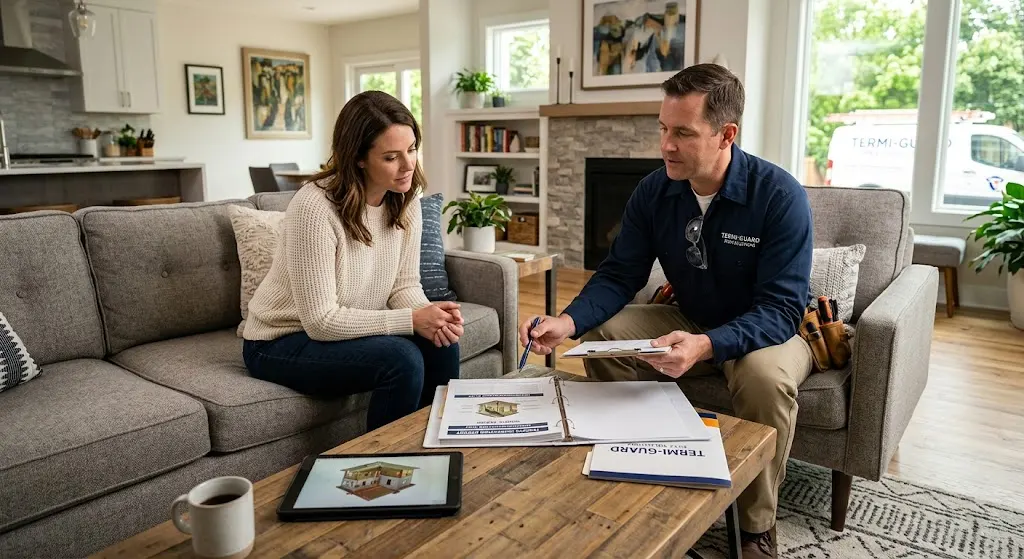
Most homeowners spend somewhere between $275 and $1,032 on termite treatment, with the national average sitting around $558 to $621, according to data from HomeAdvisor and PestGnome. Minor infestations caught early can cost as little as $135, while complex cases — especially those needing whole-home fumigation — can climb to $1,390 or more.
For the most severe infestations requiring full tenting and fumigation, costs jump significantly. You could be looking at $2,000 to $8,000 depending on your home’s size and the extent of the problem. That’s a wide range, which is why it helps to understand what actually moves the needle on price.
What Factors Affect Termite Treatment Cost?
Several things shape your final bill. The treatment method, the type of termite, and the size of your home are the three biggest cost drivers. But there’s more to it than that.
Size of the infestation is probably the most important factor. A small, newly detected colony caught before it spreads runs $300 to $750 because the technician can target a limited area. A moderate, established colony that has spread through several rooms generally costs $800 to $1,600. A severe infestation requiring whole-home treatment pushes into the $2,000 to $3,800-plus range.
Home size also plays a direct role. Termite treatment is typically priced per linear foot or per square foot, so larger homes cost more. The general rule is $0.50 to $1.75 per square foot, depending on the method used.
Location makes a difference too. Homeowners in New York pay the highest average in the country — around $1,000 per treatment — while markets like New Jersey and Pennsylvania average closer to $738. Costs tend to be higher in areas with dense termite populations, like the Southeast and Gulf Coast.
Termite Treatment Cost by Method
The treatment method your pest control company recommends depends on the type of termites you have and how far they’ve spread. Here’s what each option typically costs.
Liquid Barrier Treatment
Liquid termiticide is the most common treatment method. Technicians apply a pesticide around and beneath your home’s foundation, creating a chemical barrier that either kills or repels termites on contact. Products like Termidor are well-known in this category.
Liquid barrier treatment costs $3 to $16 per linear foot, or $500 to $2,000 for a whole-home application. The wide range comes down to the size of your home’s perimeter and how deeply technicians need to treat the soil. One major advantage of this method is its longevity — modern liquid termiticides typically last five to twelve years before reapplication is needed.
Termite Bait Stations
Bait stations are a slower-acting but increasingly popular option. Plastic monitoring stations get installed in the ground around your home’s perimeter, spaced about ten to fifteen feet apart. They contain a cellulose material laced with a slow-acting insecticide. Termites feed on the bait, carry it back to the colony, and spread it to other members — including the queen.
Bait station systems cost $8 to $12 per linear foot for installation, plus $250 to $400 per year for monitoring. A complete system covering an average home runs $1,000 to $2,500 upfront, with annual monitoring fees on top of that. The delayed action of bait stations is actually a feature, not a bug — it ensures the poison spreads through the entire colony before termites realize something’s wrong.
Termite Tenting (Fumigation)
When an infestation has spread through multiple rooms or throughout the structure, pest control companies often recommend tenting with gas fumigation. The entire house gets sealed under a large tent, and a termite-killing gas is pumped in. It’s the most thorough option available.
Fumigation costs $1 to $4 per square foot, or $2,000 to $8,000 for an average-sized home. The process takes one to three days, during which you, your family, pets, and even houseplants cannot be inside. It’s disruptive, but nothing clears a whole-house infestation faster. One important note: fumigation works on drywood termites but is not effective against subterranean termites.
Heat Treatment
Heat treatment follows a similar process to fumigation — the home gets sealed under a tent — but instead of toxic gas, technicians use dry hot air to raise the interior temperature to between 120 and 140 degrees Fahrenheit for 35 to 60 minutes. That level of heat kills termites hiding inside wood joists, floors, and furniture without leaving any chemical residue.
Heat treatment costs around $2,000 to $6,000 for an average 2,000 square foot home, or roughly $10 per linear foot. It’s a solid choice for severe drywood termite infestations where avoiding chemicals is a priority.
Spot or Localized Treatment
If termites are caught early and limited to one or two areas, a spot treatment can handle the problem without full-home intervention. Technicians use a combination of heat, microwave guns, or direct liquid termiticide injection depending on where the termites are and what type they are.
Spot treatments cost $200 to $900 depending on the number of infested areas, and micro-treatments run $6 to $8 per square foot. These are the most affordable options and work well when the infestation hasn’t had time to spread.
Cost by Termite Species
Not all termites are the same, and the species you’re dealing with directly affects both the treatment method and the price.
Subterranean termites are the most common species across the U.S. They live in underground colonies in the soil and build mud tubes to travel between their colony and your home’s wood. Because colonies can contain millions of individuals, treatment must reach the colony at its source. Liquid barrier treatments and bait systems are the preferred methods, costing $500 to $2,000 for most homes.
Drywood termites are common in warmer climates and don’t need soil contact. They live entirely inside the wood they eat, which means they can infest attics, window frames, furniture, and any exposed wood. Treatment options are more complex — spot treatments for localized infestations, or whole-home fumigation for widespread cases. Drywood termite treatment generally costs $225 to $2,500 or more.
Formosan termites, sometimes called “super termites,” are a particularly aggressive subterranean species. They often require a combination of treatments — bait systems, liquid soil treatments, and sometimes fumigation — which pushes costs to the higher end of the range.
Annual Termite Prevention and Inspection Costs
Getting rid of termites is only half the battle. Keeping them from coming back requires ongoing prevention.
An annual termite inspection typically costs $125 to $350. Over five years, that’s roughly $625 to $1,750 total — still far cheaper than paying to treat a fresh infestation. Most pest control companies that install bait systems or liquid barriers include one annual inspection as part of the service, but confirm this before signing any contract.
Annual termite prevention programs run $200 to $900 per year and may include monthly, quarterly, or annual treatments depending on your home’s termite history and the method used.
What Is a Termite Bond?
A termite bond is a service contract between you and a pest control company. It typically covers annual inspections, retreatment if termites return, and in some cases, repair costs for any new damage that occurs under the bond.
Basic termite bonds run $500 to $2,500 upfront. Repair bonds — the most comprehensive option — cost $250 to $500 per year and cover both retreatment and structural repairs. If you live in a termite-prone area, a bond is worth serious consideration. It’s the closest thing to “termite insurance” that actually exists.
Termite Damage Repair Costs
Treatment gets rid of the termites. But it doesn’t fix what they already destroyed. Repair costs are a separate expense, and they can be significant.
The national average for termite damage repair is around $1,800 to $3,000. Minor damage — replacing a few boards or damaged floorboards — runs a few hundred dollars. Damage to walls and flooring can reach $3,000. For major structural damage, such as compromised load-bearing beams or support walls, costs can exceed $10,000. In the most severe cases, structural repairs run $25,000 or more.
Here’s the part that stings for most homeowners: standard homeowners insurance policies almost never cover termite damage. Insurers classify it as preventable maintenance, not a sudden accidental event like a fire or storm. Some HO-3 policies do include a collapse provision that may trigger coverage if a structure suddenly collapses due to hidden insect damage — but that’s a narrow exception, not the rule.
Your best protection against being on the hook for repair costs is early detection and a termite bond with repair coverage.
How to Save Money on Termite Treatment
Termite treatment is rarely cheap, but there are ways to keep costs reasonable.
Catch it early. The single most effective way to lower your treatment bill is to detect an infestation before it spreads. Schedule annual inspections if you live in a high-risk area. Early detection means spot treatment instead of whole-home fumigation — and that difference can be thousands of dollars.
Get multiple quotes. Prices vary widely between pest control companies. Get at least two or three estimates before committing. Make sure each quote uses the same treatment method so you’re comparing apples to apples.
Ask about treatment warranties. Many companies offer one to two year warranties on their work. If termites return within that period, retreatment is covered at no additional charge.
Consider a termite bond. If you’ve dealt with termites before or you live in a region where they’re common, a bond can save you significantly over time. The annual cost is predictable, and you avoid large surprise bills.
Pre-treat during renovations. If you’re remodeling or building an addition, have structural wood treated with liquid termiticide before walls go up. It’s far cheaper to do this during construction than to treat after an infestation takes hold.
Is Termite Treatment Worth the Cost?
Without question, yes. The cost of treatment — even at the high end — is a fraction of what termite damage repair runs. Termites cause an estimated $5 billion in property damage across the United States every year, and the average homeowner spends $3,000 or more just on repairs — before accounting for treatment. Untreated infestations can cost $40,000 to $50,000 in structural repairs in the worst cases.
Paying $600 to $2,000 now to eliminate an active colony is a straightforward financial decision. The longer you wait, the more the colony grows, the more damage accumulates, and the more expensive every part of the solution becomes.
If you see mud tubes along your foundation, hollow-sounding wood, discarded wings near windows, or frass (tiny wood-colored pellets) near baseboards — call a licensed pest control company the same day. The treatment cost you get quoted today will be lower than the one you get six months from now.