

Prefab cabinets cost $100–$300 per linear foot and install in one to three weeks. Custom cabinets run $500–$1,200 per linear foot and take six to twelve weeks to build. Prefab wins on price and speed. Custom wins on fit, materials, and long-term durability.
Picking cabinets is one of the biggest decisions in any kitchen or bathroom remodel. It’s also one of the most expensive. Before you sign a contract, you need to know exactly what you’re paying for and why the price gap between custom and prefab cabinets is so wide.
This guide breaks down real costs, honest pros and cons, and the questions that actually matter when you’re choosing between the two.
What Custom and Prefab Cabinets Actually Mean
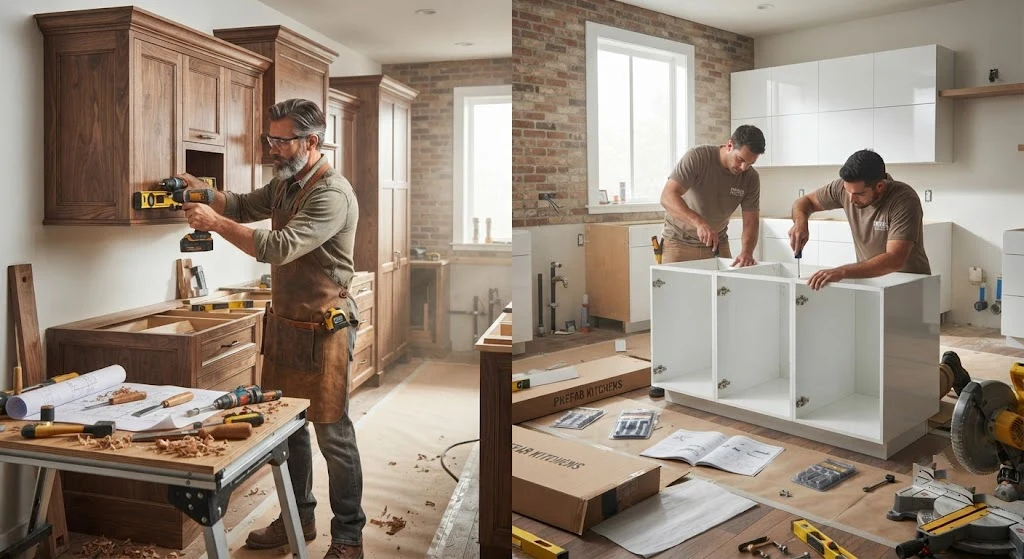
Custom cabinets are built to your exact measurements, from scratch, by a cabinet maker or shop. Every dimension, every wood type, and every finish gets chosen by you. Nothing is off the shelf.
Prefab cabinets, sometimes called stock or ready-to-assemble cabinets, come in standard sizes from a factory. You pick from a set list of widths, heights, and finishes, then install them as-is or with minor tweaks. They ship flat-packed or pre-assembled, ready to go into a wall run without any custom fabrication.
There’s also a middle option called semi-custom. These start as factory-built cabinet lines but allow for some changes, like depth adjustments or expanded finish choices. They land in price and quality between the other two.
Custom Cabinets: What You’ll Actually Pay
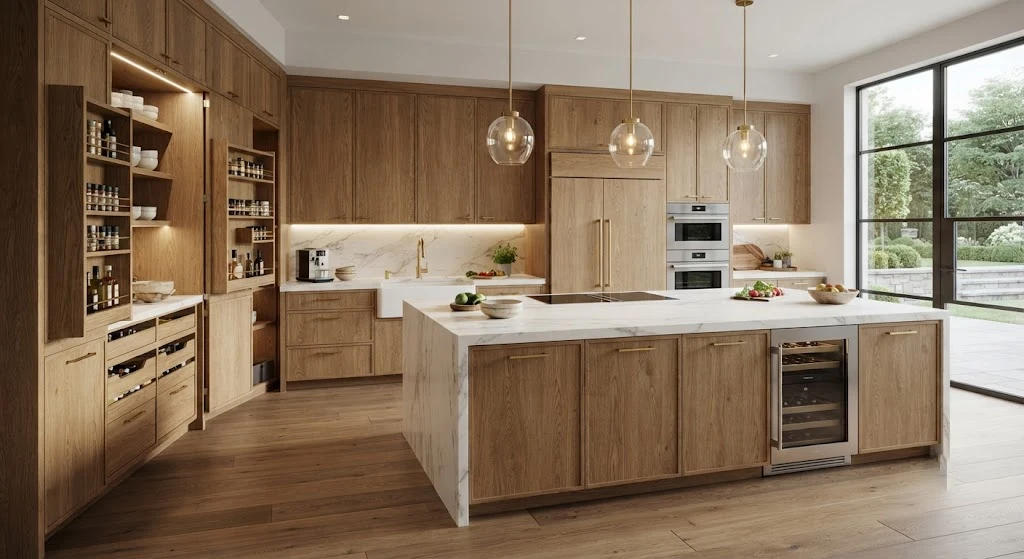
Custom cabinets cost between $500 and $1,200 per linear foot installed, according to HomeAdvisor, which notes that materials alone make up $300 to $750 of that per-foot price. For a standard 10×10 kitchen with about 20 linear feet of cabinetry, that puts the total cabinet cost somewhere between $10,000 and $24,000.
One cabinet maker breaks this down further, pointing out that a typical 10×10 kitchen usually lands between $12,000 and $20,000 for custom cabinets alone. That number climbs fast with larger kitchens, premium wood species, or specialty features like a built-in pantry or integrated appliance panels.
Timeline matters here too. Custom cabinets are built one order at a time, so a full custom build typically takes six to twelve weeks or longer before installation can even begin. If your remodel has a tight deadline, that lead time needs to factor into your planning from day one.
Prefab Cabinets: What You’ll Actually Pay
Prefab cabinets run far cheaper. Ready-to-assemble cabinets typically cost $100 to $300 per linear foot and arrive within one to three weeks of ordering. For that same 10×10 kitchen, you’re looking at roughly $2,000 to $6,000 for the cabinets themselves.
Some retailers price prefab even lower on the entry end. Basic prefab cabinets can run as low as $60 to $200 per linear foot, which could bring a 10×10 kitchen install down to around $1,000 to $4,000 total. The exact number depends heavily on where you shop, since big-box store lines sit at the bottom of that range while nicer prefab lines with upgraded hardware and finishes push toward the top.
Speed is the other big draw. Because prefab cabinets are mass-produced and kept in stock, installation can often start within days of delivery instead of weeks.
Semi-Custom: The Middle Ground
If neither extreme fits your budget or timeline, semi-custom cabinets deserve a look. These factory-built lines allow for modifications like depth reductions or expanded finish options, typically running $150 to $650 per linear foot with lead times of four to eight weeks.
This option works well for kitchens that need one or two adjusted cabinets rather than a fully custom build from top to bottom. You get more flexibility than prefab without paying the full custom price tag.
The Real Pros of Custom Cabinets
Custom cabinets give you complete control. Every inch of your kitchen gets planned around your actual layout, which matters a lot if you have an awkward corner, a low ceiling, or an unusual wall length that standard sizes just can’t fill cleanly.
Material quality tends to be higher too. Custom shops generally use solid wood or marine-grade plywood instead of particle board, which holds up better against moisture, weight, and daily wear. That durability often translates into a longer lifespan for the cabinets and a stronger return when you sell your home.
You also get design freedom that prefab simply can’t match. Want a specific stain color, an inset door style, or hardware that matches an heirloom piece of furniture? A custom shop can build to that spec. Prefab cannot.
The Real Cons of Custom Cabinets
The price is the obvious downside. Custom cabinets cost roughly three to five times more than prefab for the same kitchen footprint, and that gap only grows with premium materials or complex features.
Timing is the other major drawback. Waiting six to twelve weeks for cabinets to be built means your renovation timeline stretches out significantly. If you’re managing a kitchen that’s already torn apart, that extra wait can turn into extra stress, and sometimes extra cost if you’re paying for temporary kitchen setups or storage in the meantime.
Custom orders also leave less room for last-minute changes. Once a cabinet maker starts building to your specs, adjustments become harder and more expensive to make.
The Real Pros of Prefab Cabinets
Cost is the clear win here. Prefab cabinets let you get a functional, good-looking kitchen for a fraction of what custom would cost, which frees up budget for countertops, appliances, or flooring elsewhere in the project.
Speed is just as valuable. Because these cabinets are already manufactured and often in stock, you can move from ordering to installing in a matter of days or weeks instead of months. That’s a real advantage for anyone flipping a property, working with renters, or trying to finish a remodel before a specific date.
Prefab quality has also improved a lot in recent years. Many mid-range prefab lines now use better hinges, soft-close drawers, and more durable finishes than older stock cabinets did, closing some of the gap with semi-custom options.
The Real Cons of Prefab Cabinets
The biggest limitation is fit. Prefab cabinets come in fixed sizes, so if your kitchen has an unusual layout, you may end up with gaps, filler panels, or wasted space that a custom build would have avoided entirely.
Material quality can also be a concern. Many prefab cabinets use MDF or particle board with laminate or foil finishes, which can swell, chip, or warp over time, especially in kitchens or bathrooms with higher humidity. They hold up fine for moderate use, but heavy daily traffic in a busy household can wear them down faster than solid wood.
Design options are limited too. You’re choosing from a catalog rather than designing from scratch, so if you have a very specific vision for color, hardware, or door style, prefab might not get you all the way there.
How to Decide Between the Two
Start with your layout. If your kitchen has standard dimensions and a straightforward wall run, prefab cabinets will likely fit just fine and save you a significant amount of money. If your space has odd angles, non-standard ceiling heights, or a layout that needs to maximize every inch, custom becomes a much stronger case.
Next, look at your timeline. A tight renovation schedule almost always favors prefab or semi-custom, since custom lead times can push a project out by months. If you have flexibility and no pressing deadline, that extra wait for custom cabinets becomes less of a problem.
Finally, think about how long you plan to stay in the home. If this is a forever house, the durability and resale value of custom cabinets can justify the higher upfront cost. If you’re renovating to sell soon or working within a firm budget, prefab often delivers the better return on your money.
The Bottom Line
Neither option is universally better. Custom cabinets cost more and take longer, but they deliver a precise fit, stronger materials, and full design control. Prefab cabinets cost less and install fast, with quality that’s improved enough to satisfy most everyday kitchens.
The right choice comes down to your layout, your timeline, and your budget working together. Measure your space, set a realistic number, and get quotes from both custom shops and prefab retailers before you commit. That comparison alone will tell you which option actually makes sense for your home.