

Seeing more ants after placing ant bait is normal and means it’s working. Ants carry the bait back to their colony and leave a pheromone trail for others to follow. This surge usually fades within a few days to two weeks as the colony dies off from the inside.
You set out ant bait because you wanted fewer ants in your kitchen. Instead, you walked in the next morning and found double, maybe triple, the number crawling around the bait station. Your first thought was probably that you made things worse.
You didn’t. This is exactly how ant bait is supposed to work, and understanding why can save you from giving up too soon.
Why Does Ant Bait Attract More Ants at First
Ant bait doesn’t just kill the ants you see. It’s designed to wipe out the entire colony, including the queen hiding somewhere you’ll never find. To do that, the bait has to travel from your kitchen counter all the way back to the nest.
That journey starts with attraction. The bait contains sugar, protein, or oil, depending on the type, mixed with a slow-acting poison. Worker ants find it, feed on it, and carry it back home. More ants show up at the bait site because word spreads fast in the ant world, and that word spreads through scent.
How Ant Bait Actually Works
Think of ant bait as a Trojan horse. The poison inside works slowly on purpose. If it killed ants instantly, the forager would die on the spot instead of making it back to the colony, and the whole plan would fail.
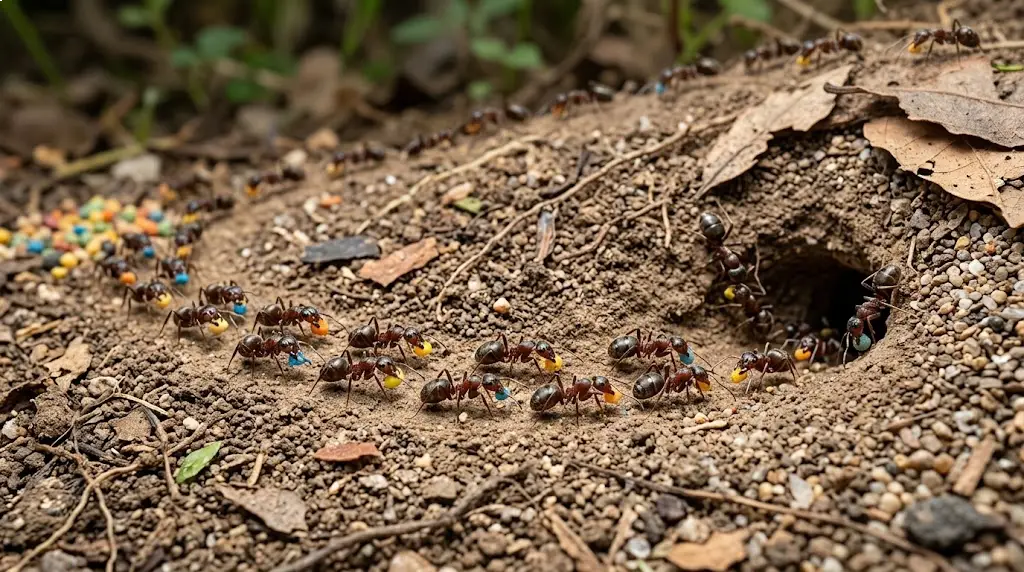
Instead, the ant eats the bait, feels fine, and heads home. Along the way, it shares the food with other workers through a process called trophallaxis, which is just a fancy term for mouth-to-mouth food sharing among ants. Eventually, the bait reaches the queen and the larvae too. Since the queen is the one laying eggs every day, taking her out is what actually ends the infestation.
The Pheromone Trail Explained
Here’s the part that explains why your kitchen suddenly looks like an ant convention. As a worker ant travels back to the nest, it leaves behind a chemical trail called a pheromone. Other ants pick up that scent and follow it straight to the bait.
More ants finding the trail means more ants finding the bait. More ants eating the bait means more poison making it back to the colony. It’s a chain reaction, and it’s working in your favor even though it doesn’t look like it.
This is also why spraying random ants you see crawling around isn’t a great idea during baiting. Killing the messengers just slows down delivery to the queen. Let them do their job.
How Long Before You See Fewer Ants
Most people notice the ant surge within the first few hours to two days of placing bait. That’s the busiest phase, since the colony hasn’t caught on yet that something is wrong.
From there, things usually calm down over the next one to two weeks. Colonies vary in size, so a small nest might disappear in days, while a larger, established one could take closer to three or four weeks. Outdoor colonies near your home’s foundation sometimes take even longer since they’re often bigger and harder to fully reach.
Patience matters more than anything else here. Pulling the bait early because you’re annoyed by the ant traffic resets the whole process and wastes the progress you already made.
Signs Your Ant Bait Is Working
You’ll know the bait is doing its job when the ant activity follows a pattern instead of just growing endlessly. A spike in numbers followed by a steady decline is the sign you want to see.
Fewer ants at the bait station each day, dead ants near the nest entrance outside, and eventually no ants at all in the areas where they used to gather are all good signs. If activity keeps climbing with no drop-off after two to three weeks, something else might be going on, like a second colony nearby or a bait that isn’t the right match for that particular ant species.
Liquid Gel and Granule Baits and How They Compare
Liquid baits tend to draw the biggest visible crowds because ants can drink them right away without carrying solid pieces. Sugar ants, odorous house ants, and pavement ants usually respond well to sweet liquid formulas.
Gel baits work similarly but come in a thicker form, often placed in small stations or applied directly with a syringe-style applicator. They tend to last longer since they don’t dry out as fast as liquid bait can.
Granule baits are better suited for outdoor use across lawns or garden beds. They don’t create the same visible swarm indoors, but they still rely on the same principle of ants carrying food back to share.
Carpenter ants can be trickier since their diet shifts between sweets and protein depending on the season. If one bait type isn’t attracting them, switching to a protein-based bait sometimes does the trick.
Common Mistakes That Make Ant Bait Less Effective
Spraying ants with a household insecticide while baiting is one of the biggest mistakes people make. The chemical scent repels ants and disrupts their pheromone trails, which cuts off the path back to the bait entirely.
Wiping down counters with strong-smelling cleaners right where you placed bait can have a similar effect. Ants navigate largely through scent, so anything that masks or removes that trail confuses their route.
Placing too little bait is another issue. If ants clear out the bait quickly and there’s nothing left, they stop returning, and the colony never gets the full dose it needs. Refilling the bait station as needed keeps the supply chain moving toward the nest.
Giving up too early is probably the most common mistake of all. Removing bait after a few days because the ant count went up instead of down interrupts a process that simply needs more time.
When to Worry About Ant Bait Attracting More Ants
A short-term jump in ants is expected. What isn’t expected is activity that keeps growing steadily for three weeks or longer with zero sign of slowing down.
That pattern can point to a much larger colony than usual, multiple nests feeding off the same food source, or a bait that just doesn’t appeal to the specific ant species in your home. Different ants have different food preferences, and even the right sugar or protein ratio can make a big difference in how well a bait performs.
If you’ve given it several weeks with no improvement, it’s worth trying a different bait formula or reaching out to a pest control professional who can identify the species and target them more precisely.
Final Tips for Ant Bait Success
Keep the bait in place, avoid spraying nearby ants, and check back every few days to track whether activity is rising or falling overall. Place bait directly along the trails ants are already using rather than randomly around a room, since that gets it into circulation faster.
Ant bait attracting more ants at the start isn’t a failure. It’s the bait doing exactly what it’s meant to do, turning a handful of scouts into an entire delivery system working against the colony from the inside. Give it time, resist the urge to spray, and the crowd you’re seeing now should be one of the last things you have to deal with.