
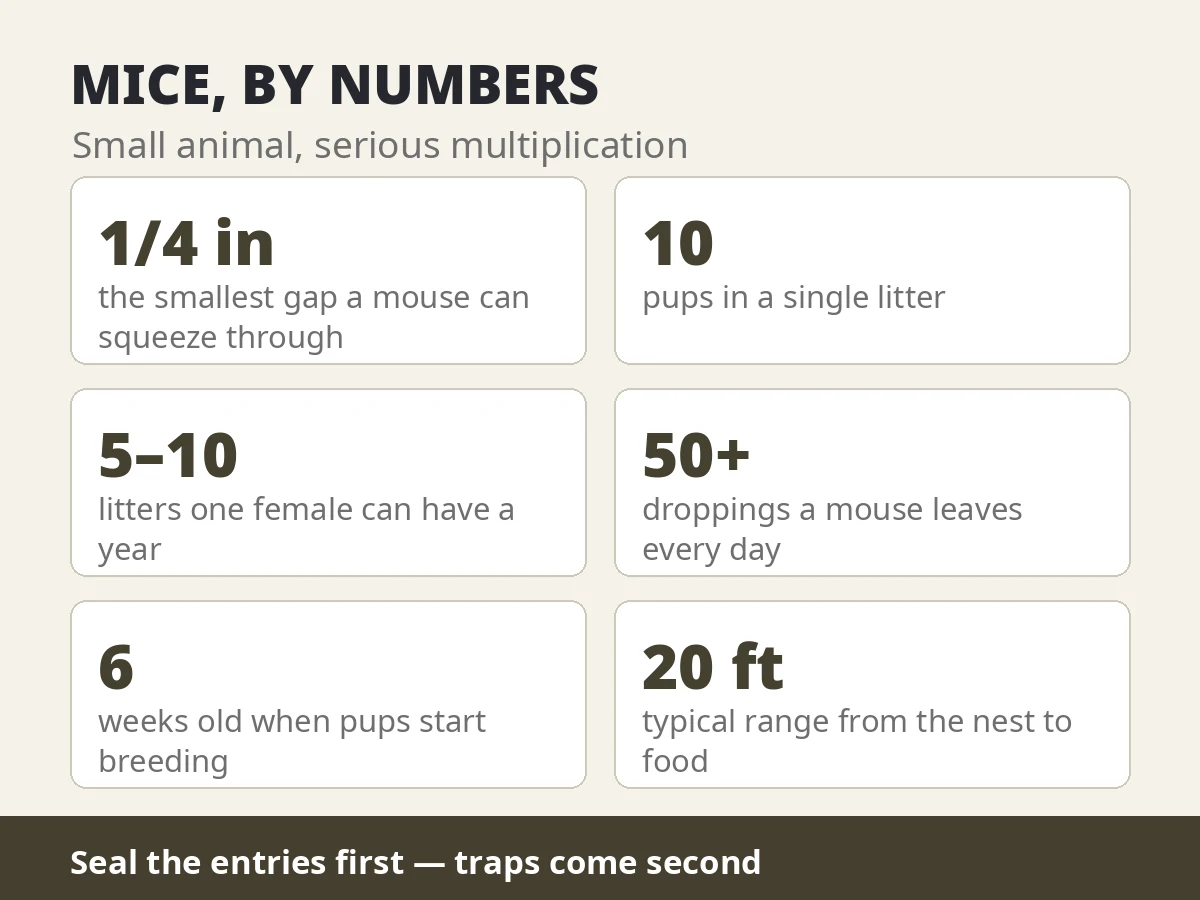
You hear it before you see it: a scratch inside the wall at 2 a.m., a pellet-filled drawer, a cereal box chewed at the corner. One mouse in the house is never just one mouse — a female can produce five to ten litters a year — so the goal is not to catch a mouse, it’s to end the colony and lock the doors behind it. This guide shows you how to get rid of mice in your house properly: confirm the signs, seal the entry points first, trap the right way, and keep them out for good.
Mice in the House at a Glance
| Question | Quick answer |
|---|---|
| How do mice get in? | Through gaps as small as 1/4 inch — around pipes, vents, garage doors and foundations |
| What attracts them? | Food (including pet food), water, warmth and hidden nesting spots |
| What works fastest? | Sealing entry points + snap traps placed along their runways |
| How long does it take? | Most homes are mouse-free in 1–3 weeks with consistent trapping and sealing |
| Are they dangerous? | They contaminate food, damage wiring (a fire risk) and can carry disease — act promptly |

Step 1: Confirm the Signs (Mouse or Something Bigger?)
House mice leave rice-sized droppings (about 1/8–1/4 inch, pointed ends) along walls, in cupboards and under sinks. Rat droppings are much larger — if yours are closer to raisin-sized, read our guide to professional rat control instead, because the approach differs. Other mouse signs: gnawed food packaging and wires, dark grease smears along baseboards where their fur rubs the same runway nightly, shredded-paper nests behind appliances, and scratching sounds after dark. The fresher the droppings (dark and soft), the more current the activity.
Step 2: Seal the Entry Points First
Trapping without sealing is mopping with the tap running. Walk the house inside and out with a pencil: any gap a pencil fits into, a young mouse fits into. Check around water and gas pipes, under sinks, behind the stove, at the garage door corners, along the foundation, and around vents and cable entries. Seal small holes with copper mesh or steel wool packed tight plus caulk; cap larger openings with 1/4-inch hardware cloth or metal flashing. Never use expanding foam alone — mice chew through it in a night. Fit door sweeps to exterior and garage doors. This single step is what separates homes that stay mouse-free from homes that re-trap forever.
Step 3: Trap the Right Way
Classic snap traps remain the most reliable tool — cheap, instant and poison-free. Placement beats quantity of bait: set traps along walls and runways where you found droppings, perpendicular to the wall with the trigger end against the baseboard, in pairs, every few feet along active routes. A pea-sized smear of peanut butter or a small piece of chocolate, pressed firmly so the mouse has to work at it, outperforms cheese. Set more traps than feels reasonable — a dozen is a normal start — and check them daily, wearing gloves. Keep traps out for at least a week after the last catch; the shy ones come last. Avoid poison bait indoors: a poisoned mouse that dies inside a wall becomes a smell and fly problem, and poison is a real risk to pets and wildlife.
Step 4: Clean Up and Remove the Welcome Mat
With gloves on, disinfect droppings areas properly: spray with a disinfectant or a 1:10 bleach solution, let it soak, then wipe — never dry-sweep or vacuum droppings, which can aerosolise contaminants. Then remove what attracted them: store dry goods and pet food in sealed hard containers, clear crumbs and grease, fix dripping pipes, and declutter nesting cover near the house — woodpiles against the wall, dense ground cover and stored boxes in the garage. Bird feeders right against the house are a mouse buffet; move them to the far end of the yard.
When to Call a Professional
If you are still catching mice after three weeks of sealed entries and heavy trapping, if the problem is in a rental, or if droppings are appearing in multiple separate areas (suggesting several entry points or a large colony), a professional exclusion service is worth it — they find the entries homeowners miss. Our overview of rodent control basics explains what a full service includes, and the exterminator services guide covers what to expect on the day.
Explore More Pest Control Guides

FAQs About Getting Rid of Mice
What is the fastest way to get rid of mice in the house?
Seal every entry point you can find, then run a line of baited snap traps along the active runways. Sealing stops reinforcements; traps remove the residents. Together they clear most homes in one to three weeks.
How small a hole can a mouse fit through?
About 1/4 inch — the width of a pencil, or a dime. If the head fits, the body follows, which is why pipe gaps and door corners matter so much.
Do ultrasonic repellers and peppermint oil work?
Evidence for both is weak. Mice habituate to sound quickly, and scent deterrents fade within days. They may supplement sealing and trapping, but they cannot replace them.
Why do I still hear scratching after catching several mice?
Either more mice remain — litters mature fast — or an entry point is still open. Keep traps out, and re-walk the house for missed gaps, especially around the garage and utility entries.
Is mouse poison a good idea indoors?
Generally no. Poisoned mice often die inside walls, causing odour and secondary pests, and bait is hazardous to pets, children and wildlife. Snap traps are cleaner, faster and verifiable.