

If a home test has just come back high, the first question most homeowners ask is simple: what will this cost to fix? Understanding radon mitigation cost before you call a contractor helps you budget realistically, compare quotes fairly, and avoid paying for extras your home does not need. For most US homes in 2026, a standard system falls in a predictable range and takes less than a day.
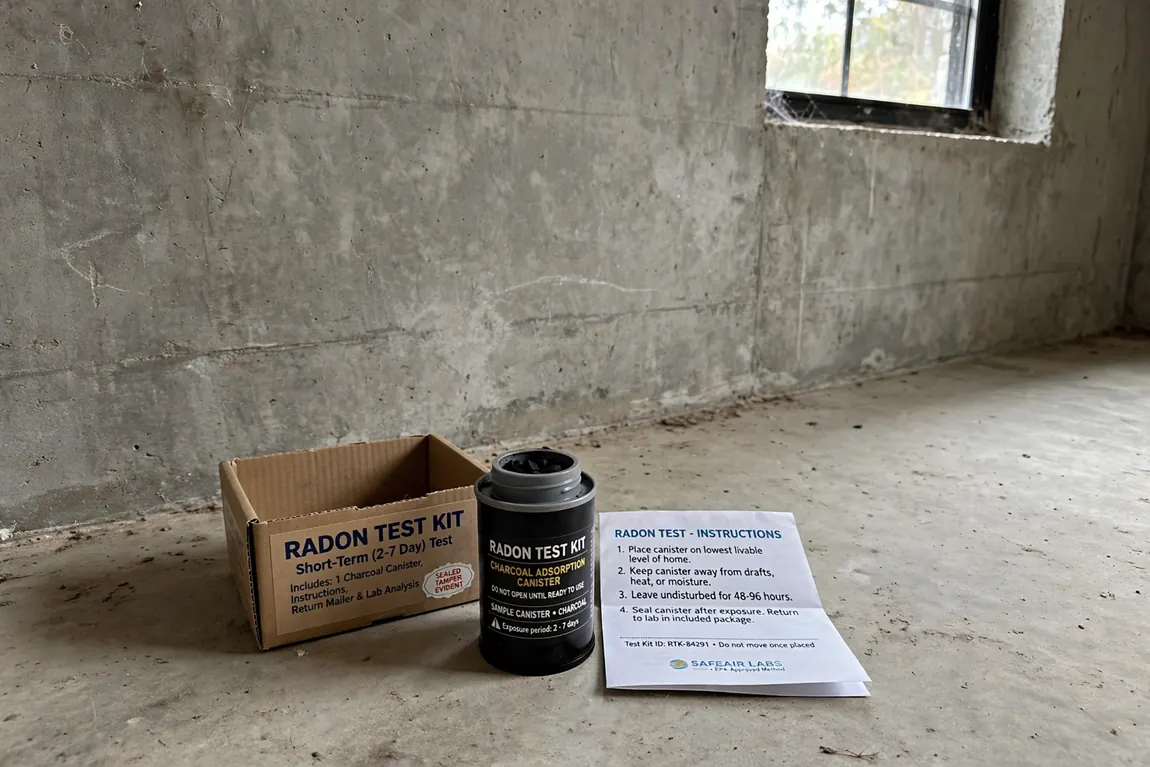
A short-term radon test kit is the inexpensive first step before you spend anything on mitigation.
What Is Radon, and When Should You Act?
Radon is a naturally occurring radioactive gas produced as uranium in soil and rock breaks down. You cannot see, smell, or taste it. It seeps in through foundation cracks, gaps around pipes, sump pits, and crawl spaces, and builds up indoors — especially in basements. Long-term exposure is the second leading cause of lung cancer in the United States, after smoking, which is why the Environmental Protection Agency (EPA) urges every homeowner to test.
The EPA action level is 4 picocuries per liter of air, written as 4 pCi/L. At or above that level, the EPA recommends fixing the home. Between 2 and 4 pCi/L, consider mitigation, particularly if you spend much time in the basement or plan to sell. Below 2 pCi/L, no action is usually needed, but retest every few years. Levels vary widely, even between neighbouring houses, so a low result next door tells you nothing about your own home.
Radon Mitigation Cost: The 2026 Price Breakdown
The national radon mitigation cost for the most common system — sub-slab depressurization — typically runs between $1,200 and $2,000 in 2026, with many homeowners paying around $1,500 to $1,700 for a straightforward installation. Simple homes with an accessible basement sit at the lower end; large footprints, finished basements, tight soils, and homes needing more than one suction point cost more. Prices vary by region and by home, so treat the figures below as planning ranges, not quotes.
| Item | Typical 2026 Cost | Notes |
|---|---|---|
| DIY short-term radon test kit | $10–$30 | Charcoal kit, lab fee sometimes extra |
| Professional radon test | $150–$300 | Continuous monitor, common in home sales |
| Digital radon monitor (to own) | $120–$250 | Reusable, tracks levels over time |
| Sub-slab depressurization system (total, installed) | $1,200–$2,000 | Standard system; larger homes $2,000–$3,000+ |
| Radon fan alone | $150–$300 | Part cost, before labor |
| Sealing cracks and openings | $100–$400 | Supports the system; not a fix alone |
| Crawl-space membrane system | $1,500–$3,000 | Membrane plus venting system under it |
| Fan electricity, per year | $50–$100 | Runs continuously, typically 20–90 watts |
| Fan replacement (with labor) | $300–$600 | Fans usually last 5–10 years |
| Post-mitigation retest | $10–$300 | DIY kit low end, professional test high end |
Most quotes are all-in: suction pit, PVC piping, inline fan, sealing of major openings, a manometer to show the system is working, and a post-installation test. Ask for that breakdown in writing — a quote that looks cheap because it leaves out sealing or the retest is not really cheaper. If you are budgeting for other below-grade work, compare this project with our guide to basement waterproofing cost, since the two jobs are often quoted by the same local contractors.
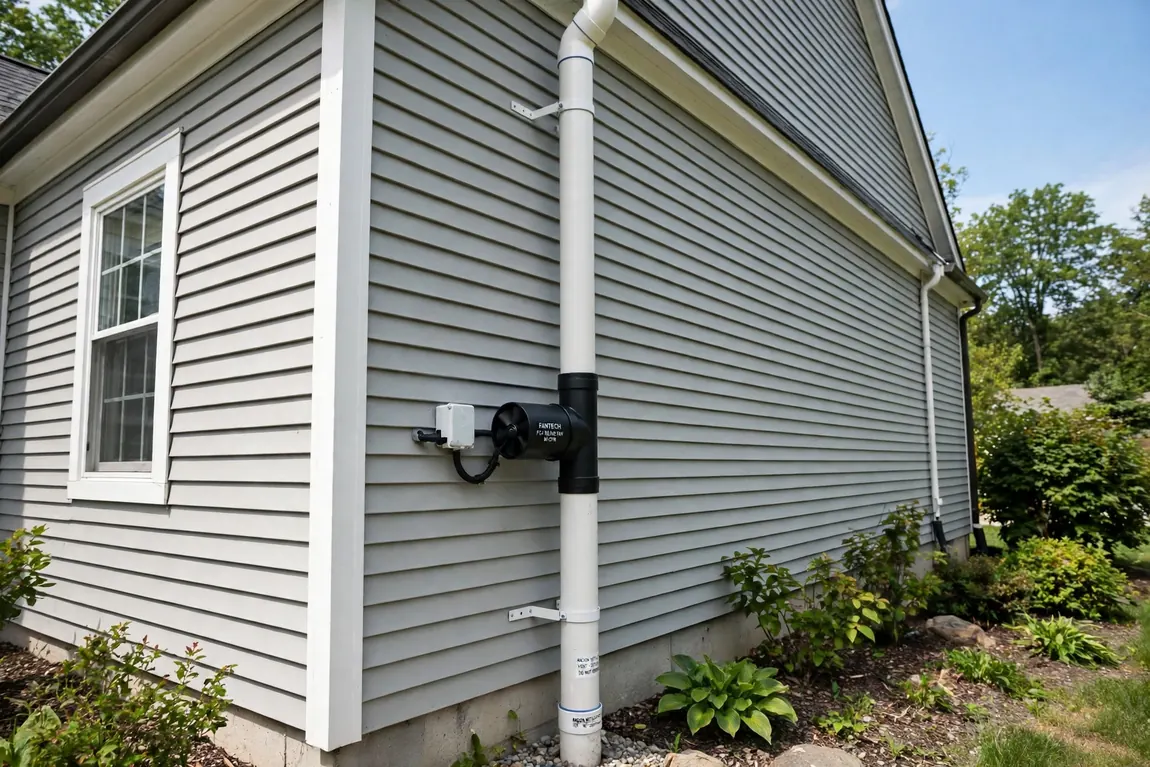
The PVC vent pipe and inline fan are the most visible parts of a typical mitigation system.
Factors That Affect the Final Price
Home size and foundation type
A large slab or a home with several foundation sections may need two or more suction points, each adding pipe, labor, and sometimes a second fan. A basement is usually the easiest foundation to treat; crawl spaces need a membrane system, which costs more.
Soil and sub-slab conditions
Loose gravel under a slab lets air move freely, so one suction point can depressurize a wide area. Tight clay restricts airflow and can require extra suction points or a more powerful fan, raising the radon mitigation cost for that home.
Routing and finishing
An unfinished basement with an easy pipe route is the cheapest layout. Routing through finished walls, closets, or an attic adds labor. Exterior runs must discharge above the roofline, away from windows.
Local labor and permit rules
Labor is the largest part of most quotes, so prices run higher in expensive metro areas. Some municipalities require a permit or a licensed electrician for the fan connection, adding $100 to $300.
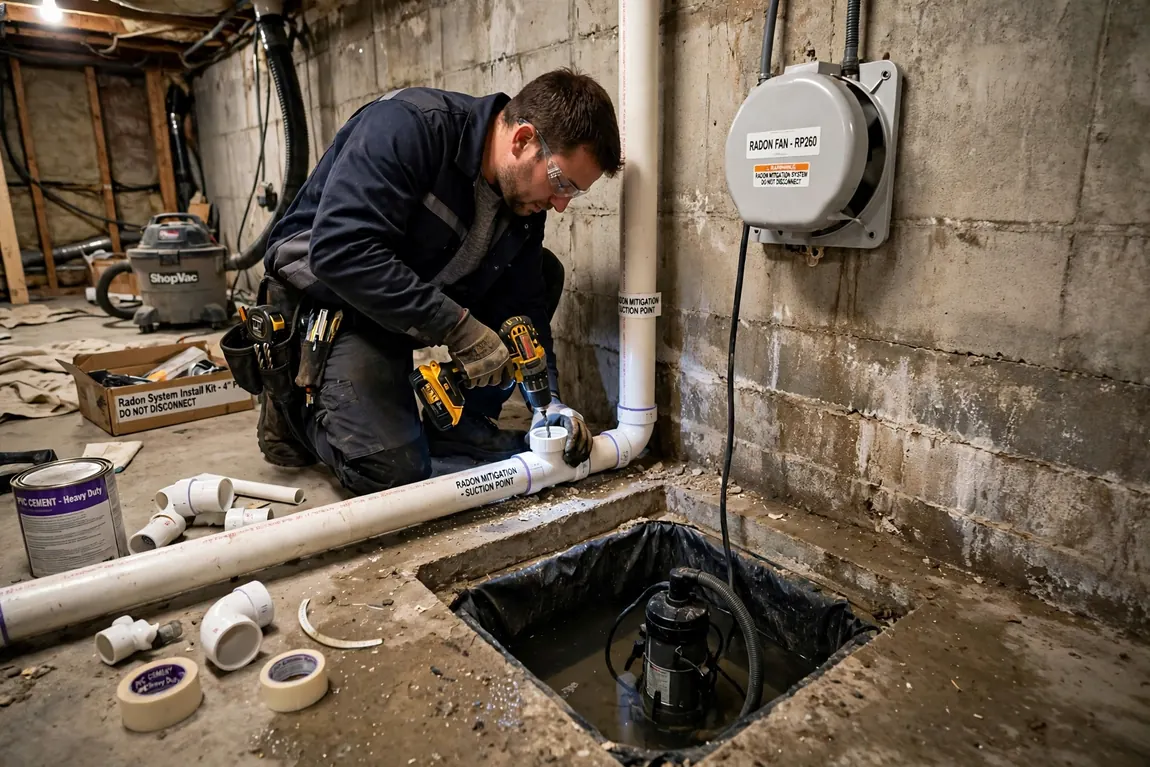
A contractor fitting a suction point in a basement — most standard systems are installed in a single day.
The Main System Types, Explained
- Sub-slab depressurization: The standard, most effective option. A PVC pipe with an inline fan draws radon from a pit under the slab and vents it above the roof. This is the system behind the typical $1,200 to $2,000 radon mitigation cost range.
- Sub-membrane depressurization: Used in crawl spaces. A heavy plastic membrane is sealed over the soil, and a fan draws radon from beneath it. Expect $1,500 to $3,000.
- Drain-tile depressurization: If your home has a drain-tile system connected to a sump pit, the fan can draw from that network, sometimes at a slightly lower cost.
- Block-wall depressurization: For hollow block foundations, suction is applied to the wall cavities. Less common, and usually priced after an inspection.
- Sealing alone: Caulking cracks improves a system’s performance, but sealing by itself rarely lowers radon enough. No reputable contractor should sell it as a standalone fix.
DIY Testing vs. Professional Mitigation
Testing is a genuine DIY job. A $10 to $30 short-term kit, placed in the lowest lived-in level for two to seven days with windows closed, gives a reliable first reading, and a digital monitor lets you watch levels change with the seasons. If buying a home, a professional test at $150 to $300 is worth it for speed and documentation — and pairs with the other checks in our guide to home inspection cost.
Mitigation itself is different. Handy homeowners sometimes install their own systems for $300 to $700 in parts, but a poorly placed suction point may barely reduce levels, bad pipe joints can leak radon back indoors, and fan wiring must meet code. A certified professional runs diagnostic testing first, guarantees a result in writing, and retests at the end. For most people, the professional radon mitigation cost is money well spent, and an uncertified DIY system can complicate a future home sale.
Ongoing Costs to Plan For
A mitigation fan runs around the clock, using roughly as much electricity as a light bulb — about $50 to $100 per year. Fans typically last five to ten years, and a fitted replacement runs $300 to $600. Check the manometer a few times a year, retest every two years, and fold both into the routine in our guide to clean your home efficiently.
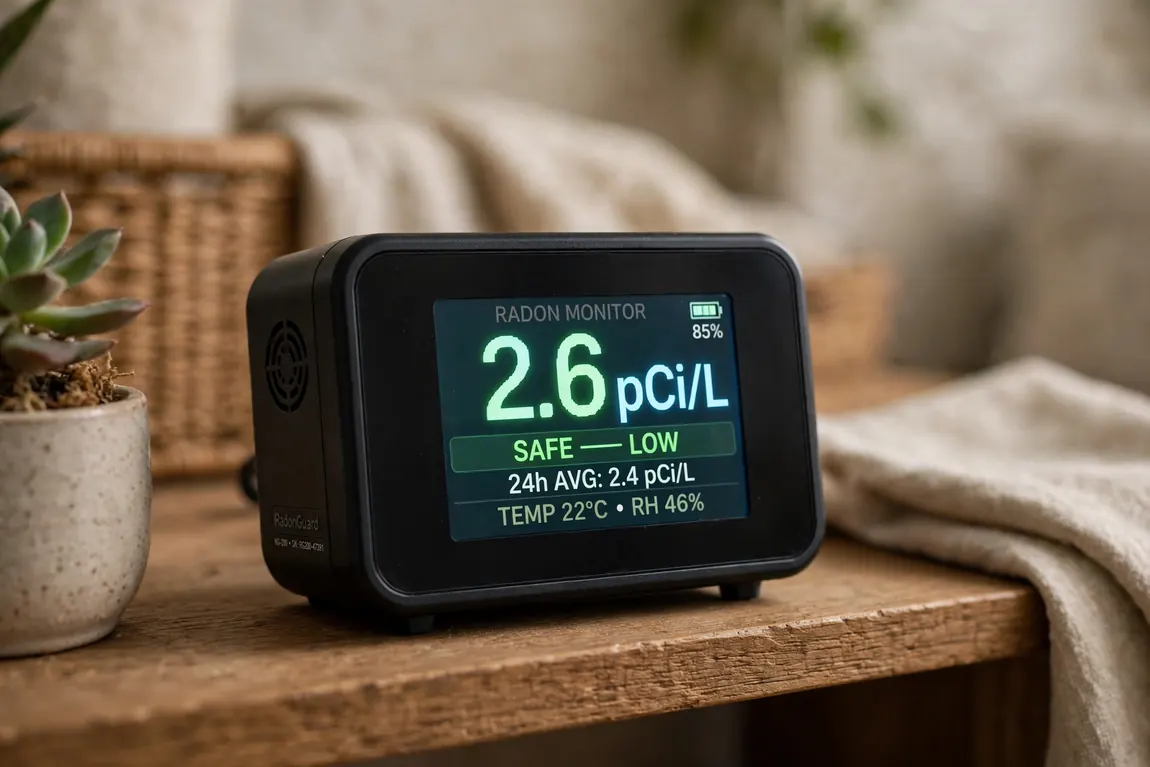
A digital radon monitor lets you watch levels long after the system is installed.
How to Get a Fair Quote
- Get two or three written quotes, and compare what each includes — suction points, sealing, retest, and warranty.
- Choose a contractor certified through a national radon program or licensed by your state, where required.
- Ask for a guaranteed post-mitigation level, ideally below 2.7 pCi/L, with a free return visit if the retest misses it.
- Check whether your state or local health department offers radon assistance or discounted testing.
- Retest after installation. Independent confirmation is cheap insurance.
Frequently Asked Questions
What is the average radon mitigation cost in 2026?
Most homeowners pay between $1,200 and $2,000 for a standard sub-slab system, fully installed. Larger homes, crawl spaces, and difficult soil can push the total to $3,000 or more.
Does homeowners insurance cover radon mitigation?
Usually not. Radon is treated as a maintenance issue rather than a covered loss, so most policies exclude it. Some sellers offer a credit toward mitigation in a sale negotiation if a test comes back high before closing.
How long does installation take?
A standard system takes three to five hours. Crawl-space systems and multi-suction-point homes can take a full day.
How much does radon testing cost on its own?
A DIY kit costs $10 to $30, a digital monitor $120 to $250, and a professional test $150 to $300. Testing is inexpensive, and there is no sensible way to skip it.
How low will a system bring my radon level?
A properly designed system commonly reduces levels by 80 to 99 percent, bringing most homes below 2 pCi/L. That is why a written guarantee and a post-installation retest matter more than the lowest headline price.