

Full overlay cabinets are a cabinet style where the doors and drawer fronts cover nearly the entire face frame of the cabinet box. When the doors are closed, very little of the frame shows. This creates a clean, continuous look across your kitchen that feels modern and well-organized.
If you’ve ever walked into a kitchen and thought, “Wow, this looks really put-together,” there’s a good chance full overlay cabinets had something to do with it. They’re one of the most popular cabinet styles in modern homes right now — and for good reason.
But what exactly makes them “full overlay”? How do they compare to other options? And are they the right fit for your kitchen? Let’s break it all down in plain language so you can make a confident decision.
What Are Full Overlay Cabinets?
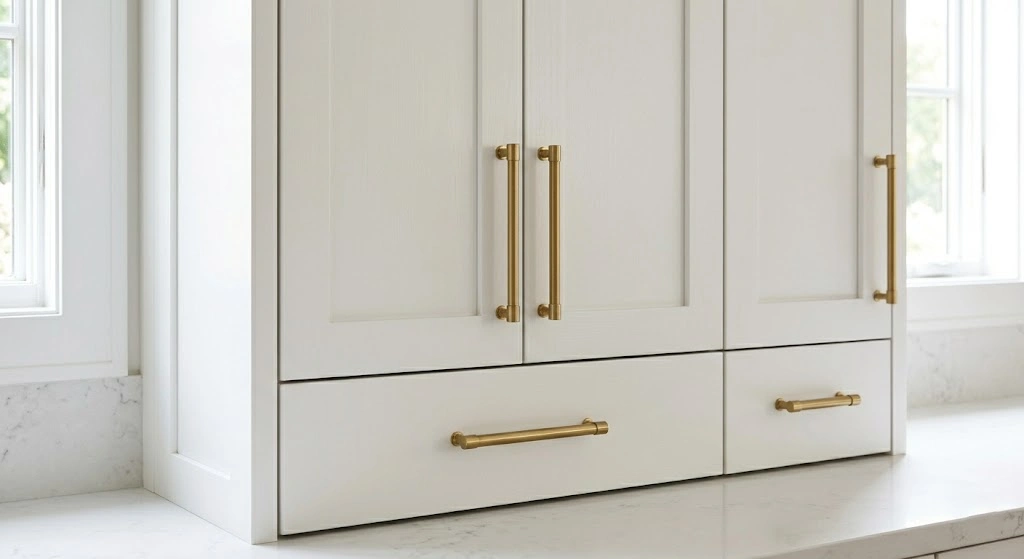
Full overlay cabinets are designed so that the doors and drawer fronts cover nearly the entire front face of the cabinet box. When everything is closed, you see almost none of the cabinet frame — just a smooth, uniform surface from one end of the kitchen to the other.
This is different from partial overlay cabinets, where the doors only cover part of the frame, leaving a visible border around each door. With full overlay, that border basically disappears. The result is a tight, clean look where the gaps between cabinet doors are very small — sometimes just 1/8 of an inch.
The style has become a go-to choice for homeowners who want a kitchen that feels modern, airy, and high-end without necessarily spending a fortune on custom cabinetry.
Full Overlay vs. Partial Overlay: What’s the Real Difference?
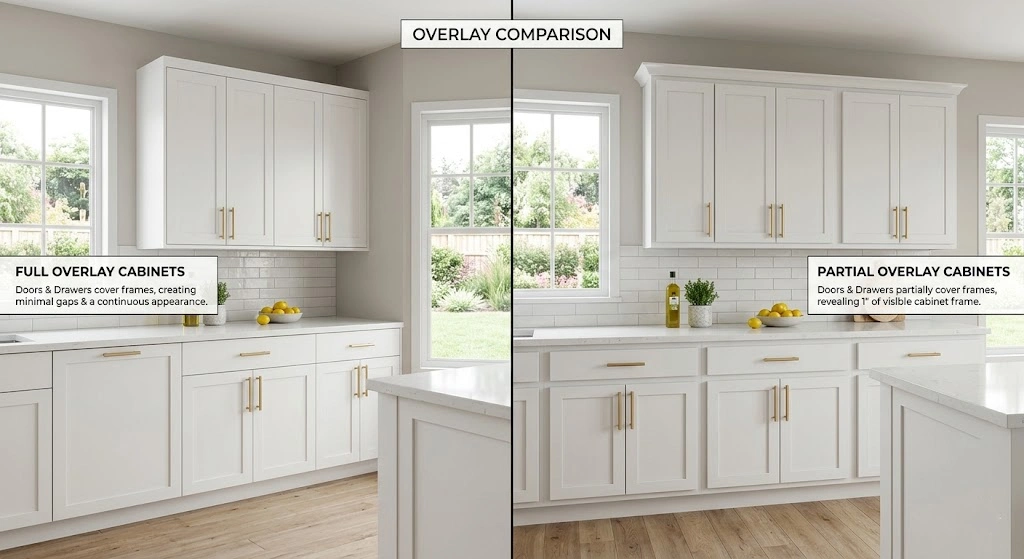
The difference comes down to how much of the cabinet frame the door covers — and how that affects the overall look of your kitchen.
With partial overlay cabinets, you can clearly see the frame between each cabinet door. This gives the kitchen a more traditional feel, with visible lines and a sense of structure. Partial overlay is also a bit easier to install because minor alignment issues are less noticeable.
Full overlay cabinets hide almost all of that frame. The doors sit closer together, the kitchen reads as one cohesive surface, and the whole space feels more unified. If you want a contemporary look — clean lines, minimal visual clutter — full overlay is the stronger choice.
In terms of cost, full overlay styles typically run about 10–16% more than partial overlay because they require more door material to cover the frame completely. That said, for most homeowners, the visual payoff is well worth the added cost.
Full Overlay Cabinets and Framed vs. Frameless Construction
Here’s something that trips up a lot of people: full overlay is a door style, not a cabinet construction type. You can use full overlay doors on both framed and frameless cabinets, and the two combinations look very similar — but they’re not identical.
Framed cabinets have a solid wood face frame attached to the front of the cabinet box. You can choose full overlay, partial overlay, or inset doors with framed construction. When you go with full overlay on framed cabinets, the doors cover nearly all of that frame, giving you a look that’s very close to frameless.
Frameless cabinets, on the other hand, have no face frame at all. The doors attach directly to the sides of the cabinet box, and full overlay is the only door style that works with this construction. Because there’s no frame reducing the opening, frameless cabinets give you slightly more usable interior space and a wider drawer opening — which is a real advantage in smaller kitchens.
Both options deliver that signature full overlay look, but frameless construction tends to work better if you’re after a more European-style, architectural kitchen where every inch of storage counts.
Why Homeowners Love Full Overlay Cabinets
There are a handful of reasons full overlay cabinets have dominated kitchen design trends through 2025 and into 2026.
The biggest draw is the aesthetic. Because the cabinet face is almost entirely covered, your eye is drawn to the material, finish, and proportion of the doors themselves — not the construction behind them. This makes the overall kitchen feel more intentional and polished, whether you go with a painted shaker style, a flat-panel slab door, or a wood veneer finish.
Full overlay cabinets also make a room feel larger. Fewer visible lines across the kitchen create a calmer, more open visual field. In smaller kitchens especially, this matters a lot. The reduced crevices between doors also make cleaning easier — there are fewer tight corners where grease and dust build up over time.
Storage access is another underrated benefit. Because the doors cover the full opening, there’s no frame edge interrupting the space when you reach inside. It’s a small thing, but it makes everyday use feel smoother.
The Hardware That Makes It All Work
Full overlay cabinets require the right hardware to look and function well. Because the frame is almost entirely hidden, there’s very little surface to grab when you open a door. That means knobs or pulls are essentially non-negotiable — they’re not just decorative, they’re functional.
Most homeowners pair full overlay cabinets with concealed, soft-close hinges. These hinges are hidden when the doors are closed, which keeps the exterior surface looking clean. They also cushion the door as it closes, which reduces wear on both the hinge and the cabinet itself over time.
One detail worth knowing: full overlay cabinet doors can typically open to about 110–120 degrees, compared to the full 180-degree swing of some standard overlay doors. In most kitchens, this isn’t a problem. But if you have tight corners or a galley layout where people are moving around each other, it’s worth thinking about how much clearance you actually need.
How to Measure for Full Overlay Cabinet Doors
Getting the measurements right is critical with full overlay cabinets. Because the doors sit very close together — with gaps as small as 1/8 inch — even small errors in sizing can throw off the alignment across the whole kitchen.
Start by measuring the width and height of each cabinet opening, from the inside edge of the frame. From there, you add the overlay amount — typically 1/2 inch to 5/8 inch on each side — to determine the final door size. For adjacent cabinets, you split the overlay between the two doors so they meet cleanly in the middle.
If you’re replacing existing doors, measure the current door size too. That tells you the existing overlay amount and helps you match or update the look without having to rebuild the cabinet boxes. If you’re uncertain about any of this, getting a professional measurement before ordering doors is always the smarter move.
Are Full Overlay Cabinets Right for Your Kitchen?
Full overlay cabinets work well in a wide range of kitchen styles — modern, transitional, contemporary, and even some softer traditional looks. If your priority is a clean, uncluttered appearance and you want the kitchen to feel cohesive and current, they’re a strong choice.
They’re also a great fit for open-plan homes where the kitchen is visible from the living or dining area. Because the cabinetry reads as one smooth surface, it integrates naturally with the surrounding space rather than drawing attention to itself.
That said, if you love the look of visible frame lines, decorative hinges, and a more classic kitchen style, partial overlay or inset cabinets might suit you better. Inset cabinets offer a furniture-like quality that full overlay doesn’t quite replicate, though they come at a higher price and require more precision during installation.
If you’re working with a tight budget, partial overlay is a reasonable starting point. But if you want something that feels modern and is easy to maintain, full overlay is hard to beat at the price point it occupies.
What to Expect During Installation
Installing full overlay cabinets isn’t wildly complicated, but it does demand precision. Because the gaps between doors are so small, any misalignment becomes obvious quickly. The doors need to be level, plumb, and spaced evenly across the entire run of cabinets.
Concealed hinges are adjustable, which helps a lot. Most European-style cabinet hinges allow for three-directional adjustment — up/down, left/right, and in/out — so you can fine-tune the fit after hanging the doors. That said, getting everything close to perfect before you start tweaking saves a lot of time.
For DIYers with solid carpentry skills, full overlay installation is manageable. But for most homeowners, especially those dealing with out-of-plumb walls or complex layouts, hiring a professional installer is worth the cost. The labor bill is still generally lower than what you’d pay for inset cabinets, which require even tighter tolerances and more hand-finishing.
Final Thoughts
Full overlay cabinets hit a sweet spot that a lot of homeowners are after: a modern, high-quality look at a cost that’s reasonable compared to premium alternatives like inset cabinetry. They hide the construction, show off the material, make the kitchen feel larger, and are easier to keep clean than more detailed styles.
If you’re planning a kitchen remodel and want a look that feels current without being trendy, full overlay is a solid place to start. Pair them with quality concealed hinges, choose your hardware thoughtfully, and get your measurements right — the rest takes care of itself.