

June bugs are reddish-brown beetles from the genus Phyllophaga that appear in late spring and summer. They feed on leaves at night, are drawn to porch lights, and spend most of their lives underground as grubs. You can control them with nematodes, milky spore, or targeted lawn care.
If you have ever sat on your porch on a warm summer night and heard a loud thud against the screen door, you already know what a June bug is. These clumsy, buzzing beetles show up every year around late spring, and they seem to have zero flying skills. They bump into walls, windows, and sometimes people, all while trying to reach the nearest light bulb.
June bugs are not dangerous. They do not bite or sting, and they will not spread disease to you or your pets. Still, they can be annoying, and their larvae can quietly wreck a healthy lawn. Here is what you need to know about these beetles, plus real ways to keep them out of your yard.
What Is a June Bug?
The name June bug refers to a large group of beetles in the genus Phyllophaga. There are nearly 300 species in this genus, and they commonly appear across the Northern Hemisphere during warm spring evenings, drawn to porch lights and streetlamps. People also call them May beetles or June beetles, since the exact month they show up depends on your region and the local weather.
Some other beetles get lumped into the same nickname, even though they are technically different species. The green June beetle and the Japanese beetle both get called June bugs in casual conversation, even though each one behaves a little differently. For most homeowners, though, the term simply means any chunky brown beetle that shows up in early summer and heads straight for the porch light.
What Do June Bugs Look Like?
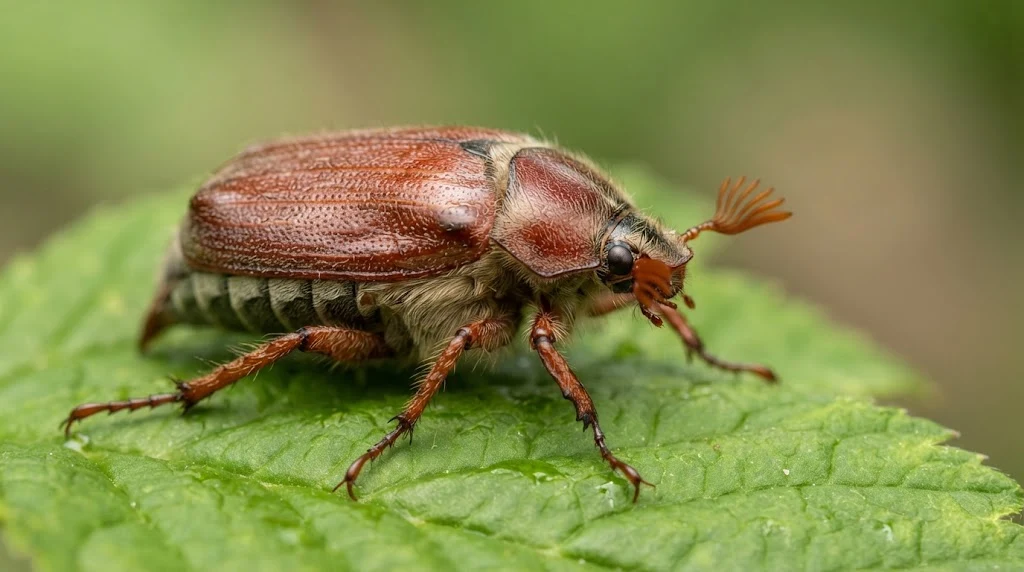
The adult June bug measures about half an inch to a full inch long, with a thick, oval-shaped body. Most of them are brown, and the shade can range from a light reddish tone to a brown so dark it looks nearly black. A smaller number of species show a metallic green color instead.
Their wings fold under a hard outer shell when they land, which is part of why they fly so poorly. That heavy shell makes them slow and awkward in the air, so they often crash into porch screens, car windshields, or anyone standing nearby. It is startling the first time it happens, but completely harmless.
The June Bug Life Cycle
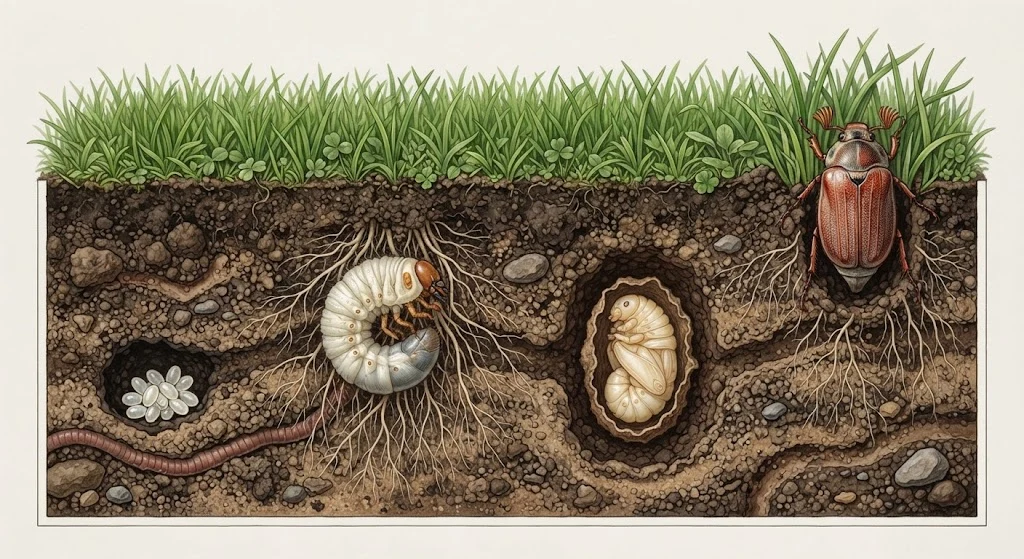
June bugs go through four stages: egg, larva, pupa, and adult. The full cycle can take anywhere from one to three years, depending on the species and the local climate.
It starts when a mated female burrows two to five inches into the soil and lays her eggs. A single female can lay between 60 and 75 eggs over about a two-week stretch during midsummer. Those eggs hatch into larvae known as white grubs, and this is where the real trouble for your lawn begins.
The grubs spend the next one to three years underground, feeding on grass and plant roots the whole time. Many species follow a three-year pattern: the grubs hatch in the soil during spring, burrow deeper as fall arrives, then sit inactive through winter. The next spring they rise closer to the surface to feed on roots again, which is usually when they cause the most damage. By the third spring, they feed once more, then enter the pupal stage in summer before emerging as full adult beetles that stay underground until the following spring. Once they finally emerge as adults, the cycle starts all over again.
Where Do June Bugs Live?
June bugs are common across North and South America, and related species also live in parts of Europe and Asia. They thrive almost anywhere with soil to burrow into and plants to feed on, which makes lawns, gardens, and farmland all attractive to them.
Adult beetles feed at night on leaves and flowers, then retreat underground during the day. Larvae live entirely below the surface, feasting on roots until they are ready to pupate. This underground lifestyle is exactly why so many people never see a problem until their lawn already has brown, dying patches.
Are June Bugs Harmful?
Adult June bugs mostly nibble on foliage, and in small numbers they rarely do much damage to your plants. The real threat comes from the grub stage, when the larvae are underground chewing through roots for months at a time.
A heavy grub population can destroy crops like corn, small grains, potatoes, and strawberries, and can kill entire sections of lawn or pasture by severing grass from its roots. If you notice spongy patches of grass that pull up easily, like a loose carpet, grubs are often the cause. Skunks, raccoons, and moles digging up your yard at night are another common sign, since they are hunting for grubs to eat.
Why Are June Bugs Attracted to Light?
Nobody knows the exact reason insects like June bugs swarm toward artificial light, but researchers have a few strong theories. One idea is that these beetles evolved to navigate by the moon and stars, and a porch light throws off that internal compass. Another theory suggests that bright light disrupts their normal instinct to avoid open, exposed areas at night.
Whatever the true cause, the result is the same every summer. Turn on your porch light, and within minutes you will likely have a few beetles bouncing off the bulb or clinging to your screen door.
How to Get Rid of June Bugs
The best control plan works on two levels at once. You want to reduce the adult beetles bothering your porch right now, and you want to stop next year’s grubs before they can damage your lawn.
For adult beetles around your house, start with your lighting. Swap bright white porch bulbs for yellow bug lights, since June bugs are far less drawn to that warmer color. Keep outdoor lights off when you are not using the space, and close blinds at night so light does not leak out and pull beetles toward your windows.
Natural Ways to Control June Bugs
If you want to avoid harsh chemicals, several natural methods work well against both grubs and adults. Beneficial nematodes are one of the most effective options. These microscopic worms hunt down grubs in the soil and kill them, and you can find them at most garden centers or order them online. Apply them to a moist lawn in early fall or mid spring for the best results.
Milky spore is another natural option, especially in areas with consistently moist soil. This is a bacterium that infects and kills grubs over time, and it keeps working in the soil for years once it is established. Essential oils like peppermint, neem, and cedarwood also repel adult beetles when sprayed around doors, windows, and other entry points, and they are safe to use around kids and pets.
Encouraging natural predators helps too. Birds, toads, and bats all eat June bugs and their grubs, so a birdbath or a small water dish can quietly reduce your beetle population over time.
How to Get Rid of June Bug Grubs in Your Lawn
Good lawn care habits make your yard far less appealing to egg-laying females in the first place. Water your grass with one to one and a half inches of water once a week, and mow it to a height of three to four inches to encourage deeper root growth. June beetles prefer laying eggs in short, thin grass, so a slightly longer lawn gives them fewer easy targets.
Raking your lawn regularly also helps by clearing away thatch, the layer of dead grass and roots that builds up at soil level. Removing that thatch exposes grubs to birds and other predators, which naturally thins out the population without any chemicals at all.
If an infestation is already severe, a targeted grub-control insecticide applied in early fall can knock down the population before winter. Always follow the label directions closely, and consider treating only the specific problem areas of your lawn rather than the entire yard.
When to Call a Pest Control Professional
Most June bug problems respond well to the steps above, but a heavy, repeated infestation may need extra help. If you are seeing large brown patches every year despite consistent lawn care, or if digging animals keep tearing up your yard looking for grubs, it may be time to bring in a professional.
A pest control expert can test your soil for grub counts, confirm which species you are dealing with, and recommend a treatment plan suited to your specific lawn. This is especially useful if nematodes or milky spore have not fully solved the problem after a full season.
Final Thoughts
June bugs are more of a nuisance than a real threat, but their grubs can quietly do serious damage if you ignore them. A few small changes, like switching your porch lights, keeping your grass at the right height, and introducing nematodes in early fall, go a long way toward keeping your yard beetle-free. Stay consistent with these habits, and you will spend far less time chasing clumsy beetles off your screen door next summer.