

New countertops change a kitchen or bathroom more than almost any other single upgrade, but quotes can be hard to compare. One bid is priced by the square foot, another bundles fabrication and fitting, and a third leaves out removal. Understanding countertop installation cost before you choose a material helps you compare like with like and set a realistic budget. This guide breaks down typical 2026 planning ranges by material, explains how counters are measured and made, and shows where to save. All prices below are typical US ranges for planning only, not quotes.
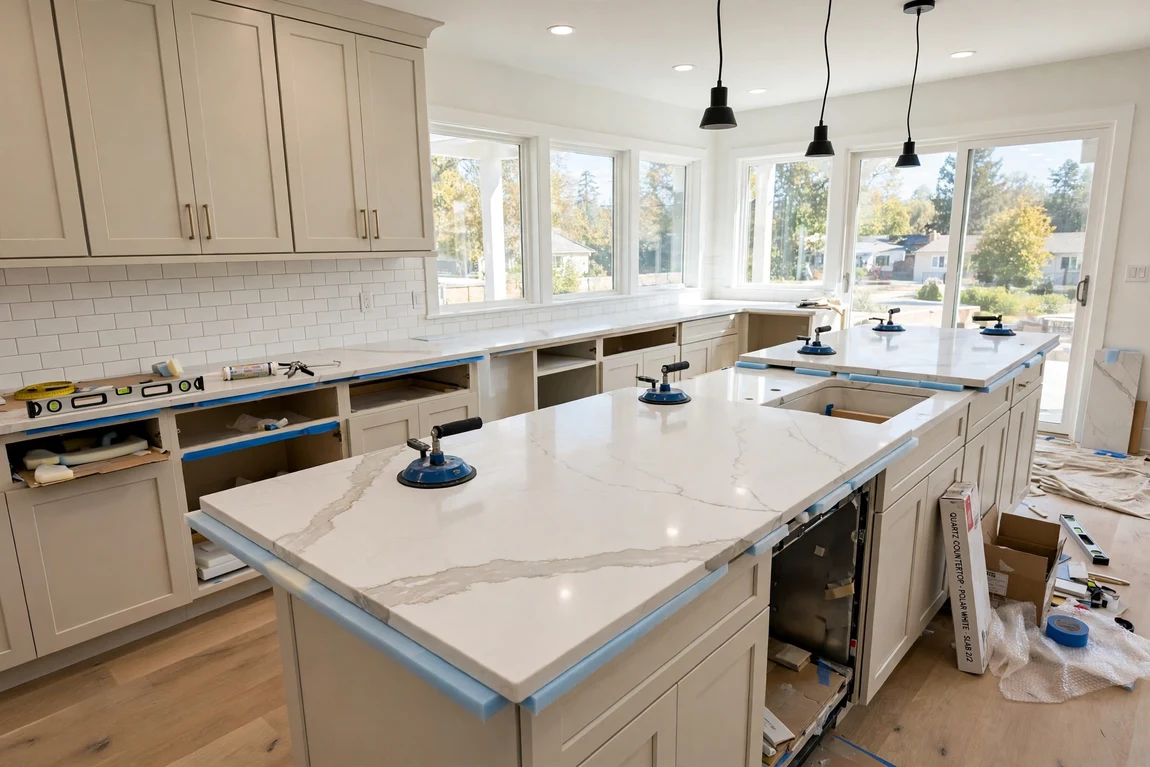
A quartz top being set onto base cabinets during fitting. (Illustrative image)
How counters are measured and priced
Most quotes are built around square footage. The installer measures the length of each run of cabinets and multiplies it by the depth of the top, usually about 25 inches for a kitchen counter. Islands are measured separately because they are deeper, and extra overhang for seating may need support brackets. The result is the square feet you are charged for, even though the raw slab may be larger, because offcuts are part of the job.
That price normally covers more than the material. It usually includes templating, fabrication, delivery, and fitting. Templating is the visit where the fabricator makes an exact pattern of your cabinets, recording uneven walls, corners, and sink and cooktop positions. Fabrication is the workshop work that follows: cutting to that template, polishing edges, and cutting holes. If a quote looks unusually cheap, check whether templating, delivery, and fitting are included or listed separately.
Our guide to kitchen remodel cost shows where countertops sit in the total budget.
What installation involves
On fitting day, the old top is removed first, and the sink, faucet, and cooktop are disconnected. The cabinets are checked for level, because a heavy stone or quartz top needs even support, and shims correct small dips. The new sections are carried in, set onto the cabinets, joined at the seams, and fixed in place. Seams are filled with colour-matched resin and levelled so the join is as discreet as the material allows.
After the top is set, the sink is mounted, the faucet and cooktop are refitted, and the wall joint is sealed. A plumber or electrician may be needed for reconnections, and that cost is not always in the quote, so ask in advance. Most straightforward installations finish in a day once fabrication is complete, but the full process from templating to fitting often takes one to three weeks because tops are made to order.
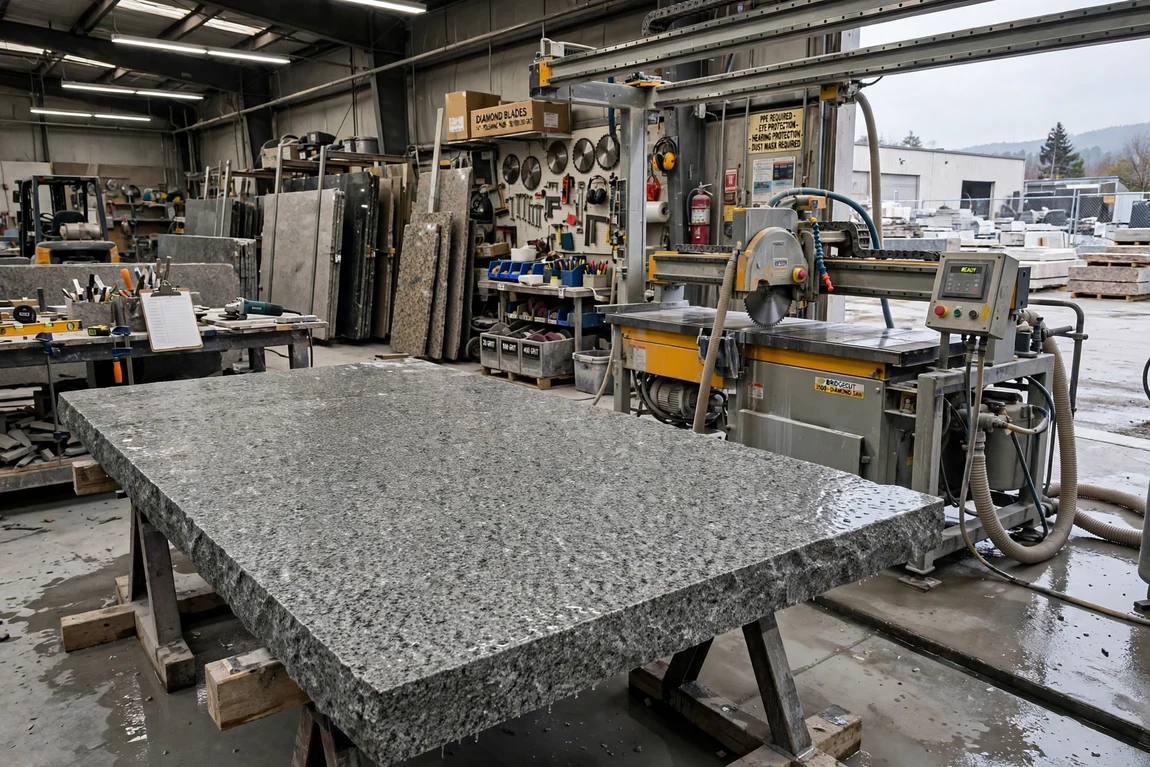
A granite slab in a fabrication workshop before it is cut to a template. (Illustrative image)
countertop installation cost by material
The table below gives typical installed ranges per square foot in the US for 2026. Treat every figure as a planning estimate, not a promise. Entry-level colours and standard edges sit near the bottom of each range, while rare colours, complex layouts, and high-cost areas sit near the top. For a rough total, multiply the range by your square footage. A typical kitchen has roughly 30 to 50 square feet of counter space, so material choice alone can move the total by several thousand dollars.
| Material | Typical installed cost per sq ft (2026 planning estimate) | Good to know |
| Laminate | $20 to $50 | Lowest cost, light in weight, can chip and scorch |
| Butcher block | $40 to $100 | Warm wood, can be sanded and re-oiled, needs regular sealing |
| Tile | $30 to $80 | Flexible for odd shapes, grout lines need sealing and cleaning |
| Granite | $50 to $120 | Natural stone, each slab unique, periodic sealing recommended |
| Quartz | $55 to $130 | Engineered stone, consistent colour, non-porous and low maintenance |
| Marble | $60 to $150 | Classic veining, softer than granite, can etch and stain |
| Solid surface | $45 to $100 | Inconspicuous seams, integrated sinks possible, scratches can often be sanded out |
Material is only one part of the bill. Material and fabrication make up the largest share, fitting and delivery come next, and removal, cutouts, and finishing details make up the rest. Ask for an itemised quote, so you compare the same work.
Factors that change the price
- Edge profile: a plain eased edge is often included, while rounded, bevelled, and ogee profiles add cost.
- Cutouts: sink and cooktop openings, and extra holes for faucets or dispensers, may be charged per cutout.
- Backsplash: a short upstand costs less than a full-height backsplash, which uses much more material.
- Removal and disposal: removing an old top, especially heavy stone, is often a separate charge.
- Layout and seams: long runs, L-shapes, islands, and corners need more cuts and seams than one straight run.
- Thickness and finish: thicker slabs and honed finishes usually cost more than standard polished.
Cabinet condition matters too. Weak or uneven base units may need repair first. If you are choosing new units, our comparison of custom cabinets vs prefab explains the cost and quality differences to weigh.
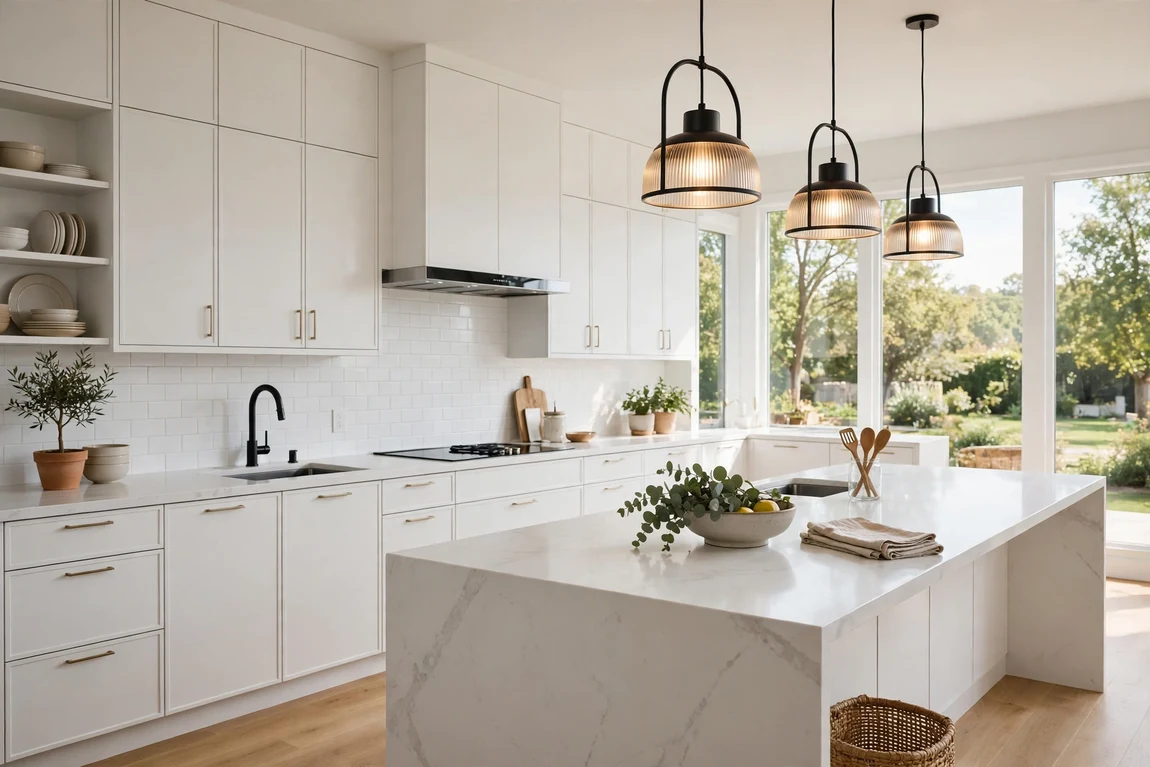
A finished kitchen with white quartz counters and a simple edge profile. (Illustrative image)
DIY vs professional installation
Some materials suit a confident DIYer. Laminate, butcher block, and tile can be cut and fitted with common tools, leaving mainly the material cost. Butcher block is especially forgiving because mistakes can often be sanded back. Removing your old counters yourself can also save the removal charge, as long as you disconnect services safely and do not damage the cabinets.
Stone and quartz are different. A section can be very heavy, can crack if carried incorrectly, and needs specialist cutting equipment. For granite, quartz, and marble, professional templating and fitting are usually money well spent, because an error in the template becomes an error in an expensive slab. Whichever route you choose, confirm who reconnects the sink and cooktop.
How to save without cutting corners
- Choose a standard colour from the stocked range instead of a special-order slab.
- Keep a simple edge profile and limit cutouts and extra holes.
- Use a short upstand or tiled backsplash instead of full-height stone.
- Keep the sink and cooktop in the same positions so plumbing and wiring do not move.
- Ask whether a remnant piece is large enough for a small vanity or utility top.
- Get three itemised quotes including templating, fabrication, delivery, fitting, and disposal.
The same approach works in a bathroom, where fitting costs per square foot can be similar. Our guide to how much it costs to retile a bathroom helps you budget both jobs.
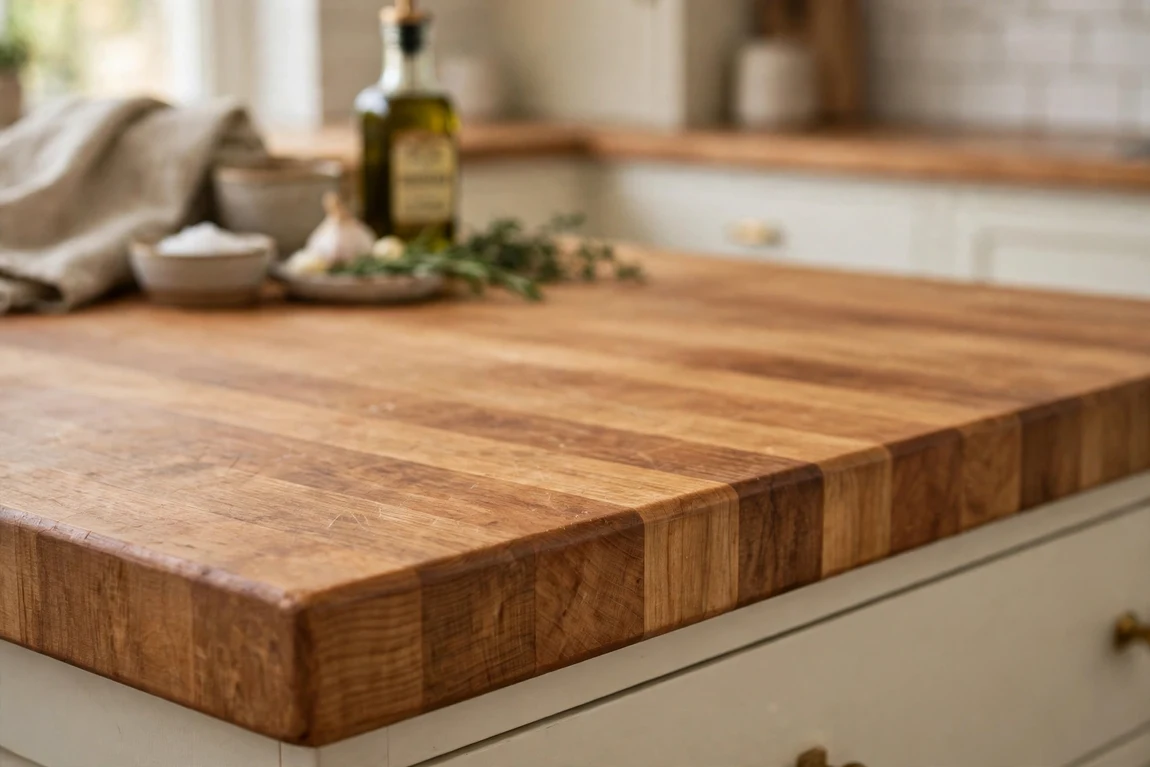
Butcher block detail, showing the grain and edge that need regular oiling. (Illustrative image)
Maintenance by material
Upkeep differs a lot, so choose a surface that suits how you live. Laminate needs little more than wiping down, but use boards and trivets because it does not handle knives or hot pans well. Butcher block should be oiled regularly, and water should not be left standing around the sink. Tile is tough, but grout is the weak point, so seal it and keep it clean.
Granite and marble are usually sealed on installation and resealed periodically, following the fabricator’s advice. Marble also etches when acids such as lemon juice sit on it, so wipe spills promptly. Quartz and solid surface do not need sealing. Protect quartz from very hot pans, and note that solid surface can often be refreshed by light sanding. Avoid harsh abrasive cleaners unless the manufacturer says they are safe.
Planning your budget
Start with your square footage, pick two or three materials, and price each using the ranges above as planning estimates. Then add the details for your layout: removal, cutouts, edge profile, and backsplash. Three itemised quotes will tell you whether your budget is realistic and where the money goes. The best value is rarely the cheapest quote. It is the material you can maintain, fitted accurately, at a total you understood before work began.