

The Kitty Knight house stands on a hill above the Sassafras River in Georgetown, Maryland, and it carries one of the most famous stories of the War of 1812. Part of that story is documented history. Part of it is legend that Maryland has told for 170 years. This article keeps the two clearly apart.
What is certain is that two 18th-century brick houses survived a British raid that burned most of their town, that a woman named Kitty Knight lived in one of them, and that both houses still stand today, joined together as a working inn and restaurant.
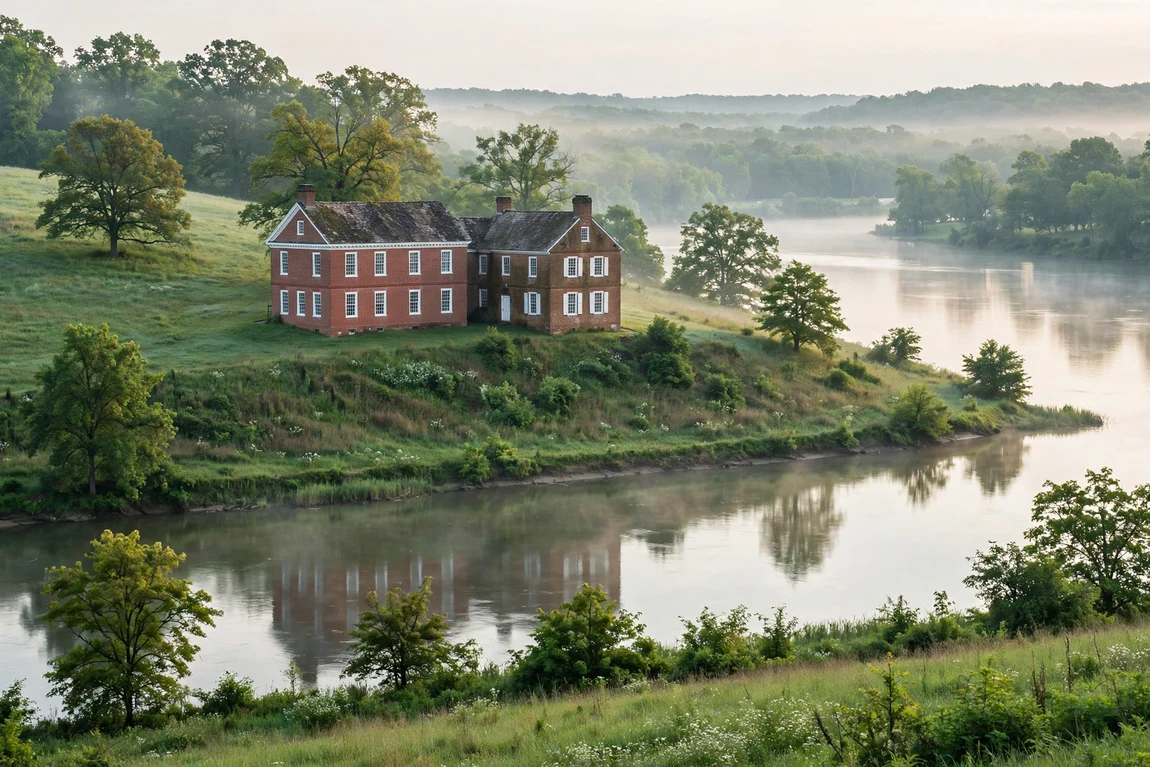
Illustrative image of a historic brick inn above a Maryland river — not the actual property.
Quick Facts
- Location: Georgetown, Kent County, Maryland, overlooking the Sassafras River
- What it is: Two joined 18th-century brick houses — the William Henry House and the Archibald Wright House
- Build date: c. 1773 per the Kent County / Maryland Historical Trust survey; the inn’s own marketing says c. 1755
- Named for: Catharine “Kitty” Knight (c. 1775–1855)
- Famous for: The night of May 6, 1813, when Georgetown was burned by British forces
- Today: An operating inn and the Deep Blue at Kitty Knight restaurant, on the Star-Spangled Banner National Historic Trail
Two Brick Houses on a Hill
Georgetown sits on the south bank of the Sassafras, in Kent County on Maryland’s Eastern Shore. Across the river in Cecil County sits its twin village, Fredericktown. In the early 1800s the two were busy little ports, and Georgetown held about 40 houses, a school, a Presbyterian church, and a shipyard.
The property now known by Knight’s name was never one house. It is two brick dwellings built side by side — the William Henry House and the Archibald Wright House — later joined into a single building. The county’s historic-site survey, carried out with the Maryland Historical Trust, dates the houses to about 1773.
The inn itself promotes a date of about 1755, and that figure appears on its signage and in many travel write-ups. No survey source supports 1755, so the honest version is this: 18th-century brick houses, dated c. 1773 by the official survey, marketed by the inn as c. 1755.
May 6, 1813: The Documented Raid
The raid itself is solidly documented. In the spring of 1813, Rear Admiral George Cockburn’s British forces were raiding towns around the Chesapeake Bay. On May 6, 1813, British troops advanced on Fredericktown and Georgetown from opposite sides of the Sassafras.
Local militia fired briefly from small earthworks at Fort Duffy and Pearce Point, then retreated. The British burned much of Fredericktown first, then crossed to Georgetown and set it ablaze as well. Contemporary records list 13 dwellings and outbuildings destroyed in Georgetown, along with a cobbler’s shop, a tavern, a granary, and a storehouse.
About ten Georgetown houses survived. Contemporary newspaper accounts quoted by the Historical Society of Kent County say only that several houses were “spared at the entreaties of the women and aged.” They do not name Kitty Knight. That detail matters for what comes next.

Illustrative image of a Sassafras River waterfront — not the actual view.
The Night the Kitty Knight house Was Saved: The Legend
The famous story is tradition, not contemporary record. As the National Park Service explains, the first known written account of Kitty Knight’s heroism appeared in her obituary in November 1855 — 42 years after the raid, with no sources cited. Everything in this section should be read as Maryland legend.
As the legend is told, Knight was living in a rented house in Georgetown that night. When the British set fire to it, she stamped the flames out herself — twice, in the NPS wording. She then pleaded with Cockburn to spare her home, and the neighbouring house of an elderly woman too ill to be moved, arguing that the wind could carry the fire from one house to the other.
A fuller version, recorded in the 1916 History of Kent County from a second-hand narrative, gives her the line: “I shall not leave; if you burn this house, you burn me with it.” Other tellings add that she swept at the flames with a broom, or hurled a burning brand back out of the house. The details grew with the telling, helped along by a 1935 historical novel, Conquering Kitty.
Legend or not, two brick houses on that hill did survive while the town around them burned — and Knight’s name became permanently attached to them.
Kitty Knight Herself
The documented woman is less dramatic but still remarkable. Catharine “Kitty” Knight was born about 1775, the daughter of prominent local parents, John Leach Knight and Catherine Matthews Knight. Later accounts describe her as a wealthy, well-connected society figure; another piece of lore claims she once danced with George Washington, which no contemporary source supports.
She was renting the Georgetown house at the time of the raid. In 1836, more than two decades later, she bought it, and she lived there for the rest of her life. She died in 1855 and was buried at the Old Bohemia churchyard of St. Francis Xavier Shrine in Cecil County.
One popular claim needs correcting: some modern write-ups say Knight bought both spared houses, joined them, and ran them as an inn herself. The National Park Service records only that she bought the house she rented and lived in it until 1855. The joining and the inn came later, under other owners.
Illustrative image of a colonial-era tavern room — not the actual interior.
The House as an Inn
At some point in their long life, the two houses were joined and converted to hospitality use, and the Kitty Knight house became one of the Eastern Shore’s best-known small inns. The property changed hands many times over the years.
In 2018, after a period of closure, it reopened under new ownership with 11 guest rooms and a renovated waterside deck. In 2021, Jamestown Hospitality Group bought the property, and the restaurant was rebranded as Deep Blue at Kitty Knight. Reports from 2025 describe the tavern at the back as the most historic part of the building, with an original low-beamed ceiling and a two-sided fireplace, and one guest room promoted as Knight’s own room from its boardinghouse days.
The inn is still operating today. Its own site describes a historic waterfront getaway with guest rooms overlooking the Sassafras, and Deep Blue serving lunch and dinner daily plus Sunday brunch. It also notes, honestly, that the 200-year-old rooms are not handicap accessible.
Is It on the National Register?
No — and this is often misstated. The house is documented in the Maryland Inventory of Historic Properties and surveyed by the Historical Society of Kent County, and it is a stop on the National Park Service’s Star-Spangled Banner National Historic Trail, with trail markers erected in 2012.
But it does not appear on the National Register of Historic Places list for Kent County. A state inventory listing and a trail stop are genuine recognition; they are simply not the same thing as National Register listing.
Illustrative image of a historic inn guest room — not an actual room.
Frequently Asked Questions
Did Kitty Knight really save the house?
Nobody can prove it either way. The raid and the burning of Georgetown on May 6, 1813, are documented, and two brick houses survived. But Knight’s role was first written down in her 1855 obituary, decades later, so historians treat the famous confrontation with Admiral Cockburn as local legend.
How old is the Kitty Knight house?
The official Kent County and Maryland Historical Trust survey dates the two houses to about 1773. The inn markets them as about 1755. The survey date is the better-sourced one.
Can you still stay at the Kitty Knight house?
Yes. It operates as the Kitty Knight Inn with 11 guest rooms, and its restaurant, Deep Blue at Kitty Knight, serves lunch and dinner daily with Sunday brunch, overlooking the Sassafras River.
Where is the Kitty Knight house?
In Georgetown, Kent County, on Maryland’s Eastern Shore, on a hill above the Sassafras River near the Cecil County line. It is a marked stop on the Star-Spangled Banner National Historic Trail.
Did Kitty Knight own the house during the War of 1812?
No. She was renting it in 1813. She bought the house in 1836 and lived there until her death in 1855.