

If white crust builds up on your faucets, dishes come out spotty and your water heater ages faster than it should, hard water is the likely cause. Before you buy, it helps to understand the real water softener cost in 2026, because the price on the box is only part of what you will pay. A professionally installed whole-house system usually runs $800 to $3,000, while simpler units and premium dual-tank systems can push the total from under $500 to $6,000 or more. This guide breaks down prices by type, ongoing costs, and how to choose the right size without overspending.
Last updated: October 26, 2026.
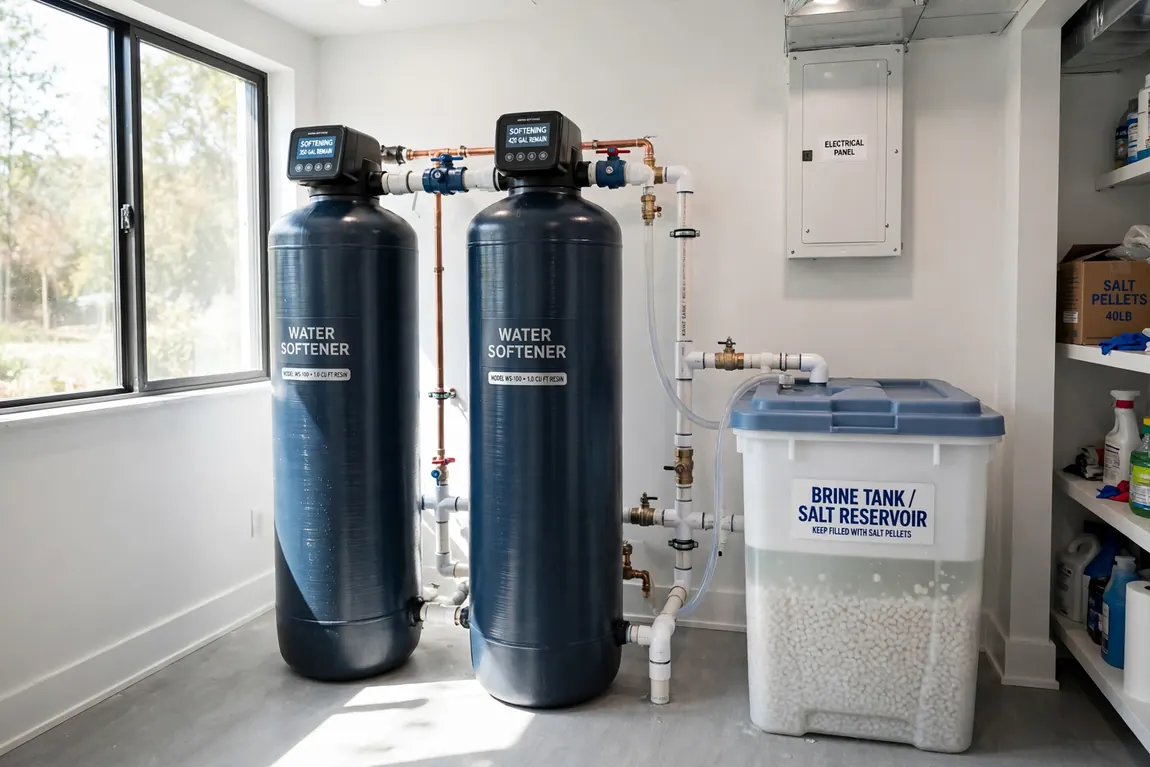
A salt-based water softener and brine tank in a utility room — the most common whole-house setup behind the average water softener cost.
What the Average water softener cost Looks Like in 2026
For a typical three-bedroom home, expect to pay around $1,500 to $2,000 installed for a standard salt-based ion exchange softener, including the unit, basic labor, fittings and startup. Salt-free conditioners often cost less to install because they need no drain or electrical connection, while dual-tank and smart-metered systems cost more upfront but handle bigger households with fewer regeneration cycles.
Prices vary by region and home size. Labor in major metro areas can run 20 to 40 percent higher than in rural areas, and long pipe runs or no nearby drain add fitting time. Get at least two itemized quotes before you decide.
| Type of System | Unit Cost | Installation Labor | Total Installed |
|---|---|---|---|
| Salt-based ion exchange | $400 – $2,500 | $200 – $600 | $600 – $3,100 |
| Salt-free conditioner | $300 – $1,200 | $150 – $500 | $450 – $1,700 |
| Dual-tank softener | $1,000 – $3,500 | $250 – $700 | $1,250 – $4,200 |
| Magnetic / electronic descaler | $100 – $400 | $0 – $200 | $100 – $600 |
A salt-based system is the only type here that truly removes calcium and magnesium. Salt-free conditioners change how minerals behave so they stick less, but they do not remove them. Magnetic units are cheapest and easiest to fit, yet independent testing is limited, so treat them as a low-cost experiment rather than a proven fix for very hard water.
Signs You Need a Water Softener
Hard water rarely causes an emergency, so signs build up slowly:
- White or chalky limescale on faucets, showerheads and kettle elements
- Cloudy spots and film on glasses after dishwashing
- Soap scum in tubs and sinks, and soap that never seems to lather well
- Dry, itchy skin and dull hair after showering
- Stiff laundry and colors that fade faster than expected
- Reduced water flow from scale narrowing pipes and fixtures
- Water-using appliances, especially water heaters, needing repair or replacement early
Scale inside a water heater makes it work harder and can shorten its life. If you are comparing water-heating upgrades too, see our guide to tankless water heater cost.
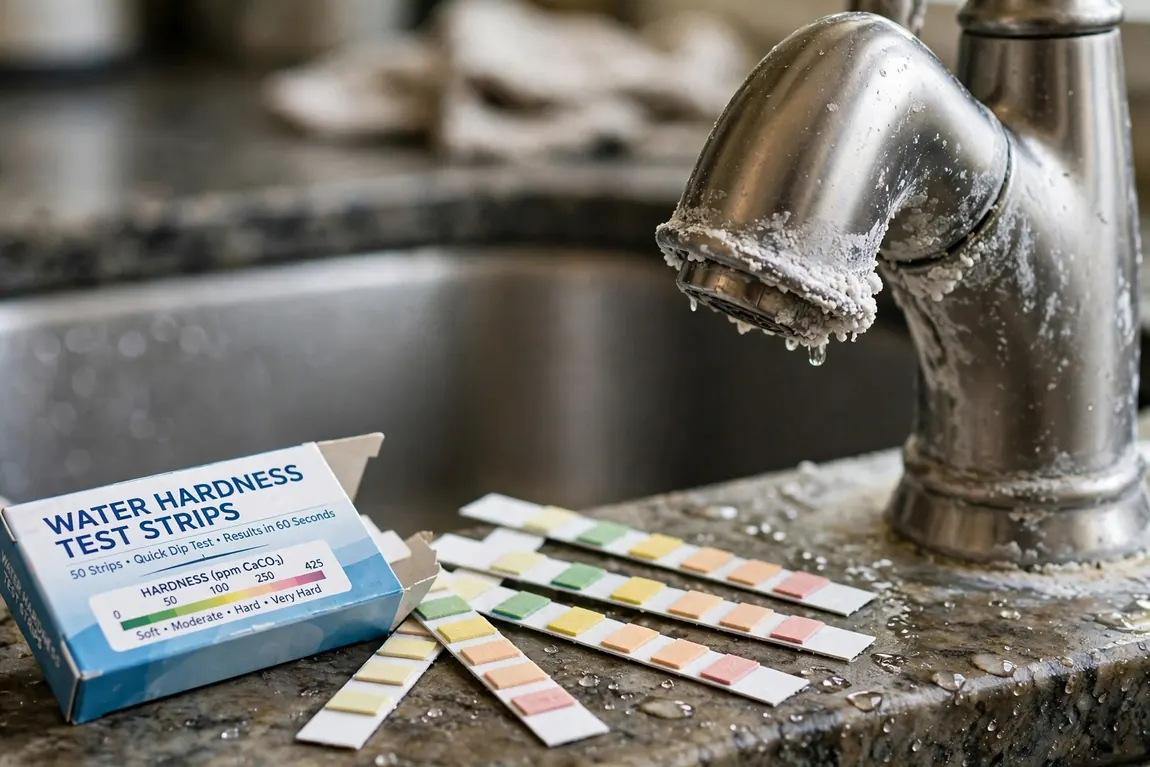
Test strips and visible limescale are simple first clues that your water is hard enough to justify treatment.
How Water Hardness Is Measured
Hardness is measured in grains per gallon (gpg) or milligrams per liter (mg/L). As a guide, 0 to 3.5 gpg is soft, 3.5 to 7 is moderately hard, 7 to 10.5 is hard, and above 10.5 is very hard. Most homes find a softener worthwhile at 7 gpg or higher. A test-strip kit costs $10 to $25, many hardware stores test a sample free, and city users can check their annual water quality report. Testing first keeps your water softener cost sensible, because hardness directly affects the size you need.
Factors That Affect water softener cost
Grain Capacity and Home Size
Softeners are sized by grain capacity — how much hardness the resin removes between regenerations. A 24,000-grain unit suits a small one-bathroom home, 32,000 to 40,000 grains fits most two- to three-bathroom houses, and larger families often need 48,000 to 64,000 grains. Bigger is not better: an oversized unit costs more and may regenerate too rarely, while an undersized one regenerates constantly and wastes salt and water.
For a sizing shortcut, multiply the people in the home by about 75 gallons a day, then by your hardness in gpg. Multiply the result by seven for a weekly capacity target.
Other Cost Factors
- Type and features: Metered regeneration and Wi-Fi monitoring add $100 to $500 but save salt.
- Plumbing condition: Older pipework or a new bypass loop adds labor and parts.
- Location: Fitting near the main line, drain and outlet is cheapest; garages and crawl spaces cost more.
- Permits and code: Some areas require a permit ($50 to $300) or restrict brine discharge, which can affect system choice.
- Pre-filtration: Homes on well water may need a sediment or iron filter first, adding $200 to $1,000.
If you are also seeing leaks, low pressure or slow drains, our roundup of common plumbing problems helps you sort out what is related and what is a separate repair.
DIY vs Professional Installation
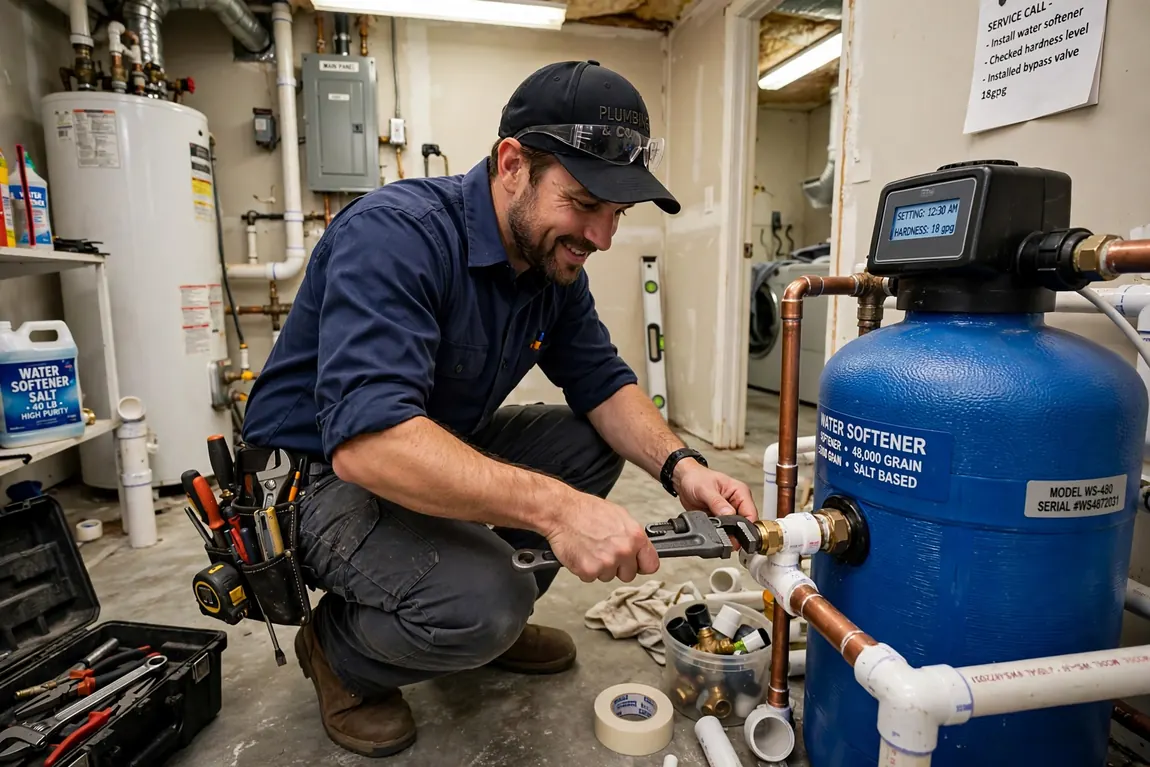
Professional installation usually takes two to four hours when a drain and power outlet are already nearby.
Confident DIYers can install a softener in half a day with push-fit or sweat fittings, saving the $200 to $600 labor charge. You will need a pipe cutter, fittings and a bypass valve. The risks are leaks, incorrect drain routing and voiding the warranty if the install breaks local code.
Professional installation usually includes sizing, code-compliant drain and backflow arrangements, startup programming and a labor warranty. It is worth it when the main line must be cut, plumbing is older, or a permit is required. See our advice on hiring a professional plumber before you book. Installation method is one of the biggest levers on total water softener cost, so price both options.
Ongoing Salt, Maintenance and Running Costs
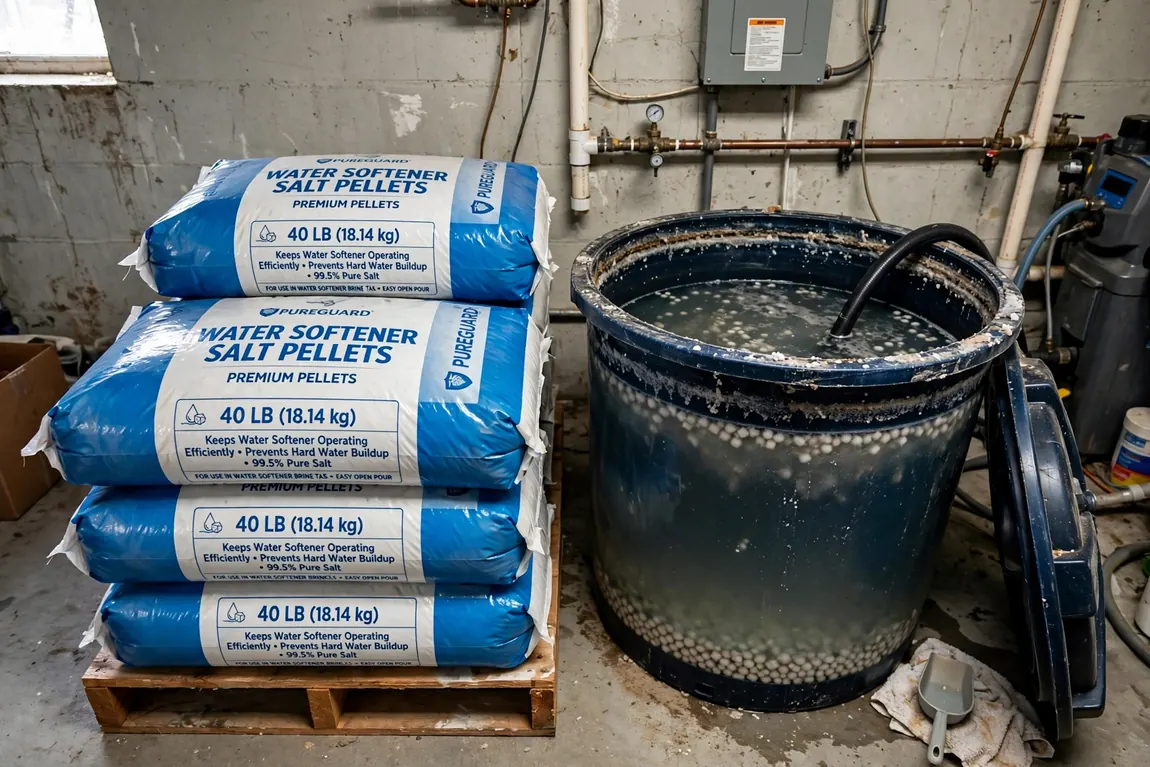
Salt is a small but ongoing part of ownership — most households use three to six bags a year.
Ownership does not end at installation. Budget $50 to $150 a year for salt — 40-pound bags cost $5 to $10 each — plus a little water and electricity for regeneration. Salt-free systems avoid salt but need media replacements instead, typically $100 to $300 every few years.
- Salt: $50 – $150 per year for most households
- Annual service visit (optional): $100 – $250
- Resin replacement: $200 – $600 every 10 to 15 years
- Pre-filter cartridges: $30 – $100 per year, if fitted
- Cleaner and sanitizer: $10 – $30 per year
Over ten years, the true water softener cost for a mid-range salt-based system is often $2,500 to $4,500 all-in — easier to justify against longer appliance life, lower detergent use and fewer scale-related callouts.
How to Keep Costs Down
Test your water first, size the system to your actual hardness and household, and choose metered regeneration over a basic timer. Get itemized quotes separating unit, labor, fittings and permit, so you can see where the money goes. Maintain the brine tank — keep salt topped up, break up salt bridges and clean it yearly. Simple care protects the investment better than buying the largest model on the shelf.
Frequently Asked Questions
How much does a water softener cost for an average home?
Most homeowners pay around $1,500 to $2,000 installed for a salt-based system in a three-bedroom home, within a typical $600 to $3,100 range. The final water softener cost depends on grain capacity, hardness, labor rates and any plumbing changes needed.
Is a salt-free system a real water softener?
Not strictly. Salt-free units are conditioners: they reduce scale sticking but do not remove hardness minerals, so a hardness test reads the same before and after. They suit mild hardness, but very hard water usually needs ion exchange.
How long does a water softener last?
A quality unit lasts 10 to 15 years, and the resin often lasts a similar period before replacement ($200 to $600). Regular salt top-ups and an annual brine-tank clean help it reach the top of that range.
Will a softener raise my water bill?
Slightly. A metered system uses 25 to 65 gallons per regeneration, a few times a week. Savings on detergent, descalers and appliance wear usually outweigh the small increase.
Can I install a water softener myself?
Yes, if you are comfortable cutting into the main line and local code allows it. Many homeowners hire a pro for the first install to get sizing, drain connection and programming right, then handle salt and cleaning themselves.