

Dry winter air can mean static shocks, cracked wood, irritated skin, and a house that feels colder than the thermostat says. A furnace-mounted humidifier treats the whole home at once, but whole house humidifier cost varies sharply by type, capacity, and how much plumbing and electrical work the installation needs.
This guide uses 2026 cost data from Angi, cross-checked with installed ranges by type from RealCostIQ. It compares bypass, fan-powered, and steam units, then covers the running and maintenance costs that continue long after the installer leaves.
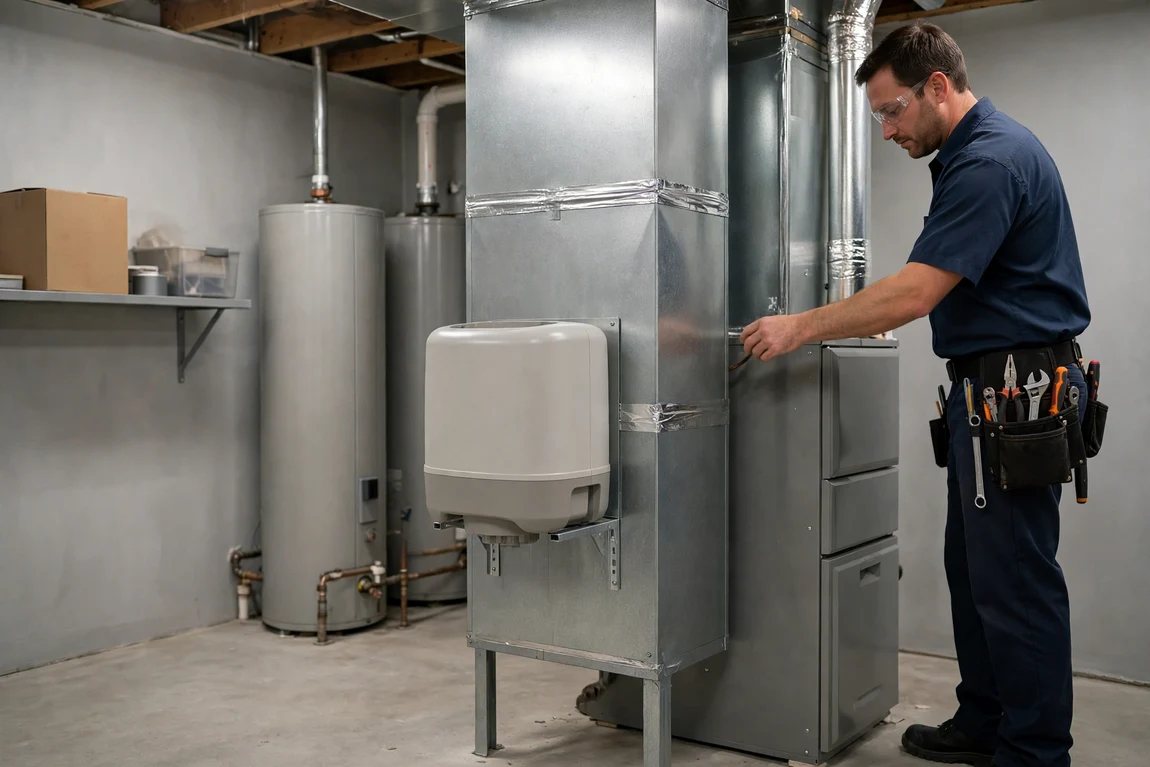
Whole House Humidifier Cost at a Glance
Angi puts the national average at $580 in 2026, based on 895 verified projects. Most homeowners pay between $392 and $768 for professional installation, with smaller budget models as low as $175 and high-end furnace-mounted units reaching $1,350, according to the Angi whole house humidifier cost guide.
Installed ranges by type tell a clearer story. RealCostIQ’s 2026 calculator, which cross-checks Angi and HomeGuide data, puts bypass units at $400 to $700 installed, fan-powered units at $500 to $900, and steam units at $500 to $2,200, in its whole house humidifier installation cost calculator.
That means total whole house humidifier cost is usually a modest HVAC add-on, not a major remodel. The exception is a large steam system with a new electrical circuit and a long water line run, where the extras can push the project well above the average.
Ask for an itemized quote. The unit, labor, water line, drain, humidistat, and any electrical work should appear as separate lines, so you can see whether a higher quote reflects a larger unit, harder access, or simply higher labor rates.
Bypass Humidifiers: The Lowest Installed Cost
A bypass humidifier mounts on the ductwork and uses the furnace blower to move air across a wet evaporator pad. It has no fan of its own, which keeps the unit simple and the price low. It only humidifies while the heating system is running air through the ducts.
RealCostIQ puts a bypass installation at $400 to $700. Angi’s unit-level data helps explain that total: drum and bypass-style units are the most affordable models, at about $100 to $300 for the unit, though they need more maintenance to prevent mold in a reservoir design.
Bypass suits many average-sized, well-sealed homes. It needs a bypass duct connection between the supply and return, plus a water feed and a drain. In a tight utility room, that extra duct can be the deciding factor between a bypass and a fan-powered model.
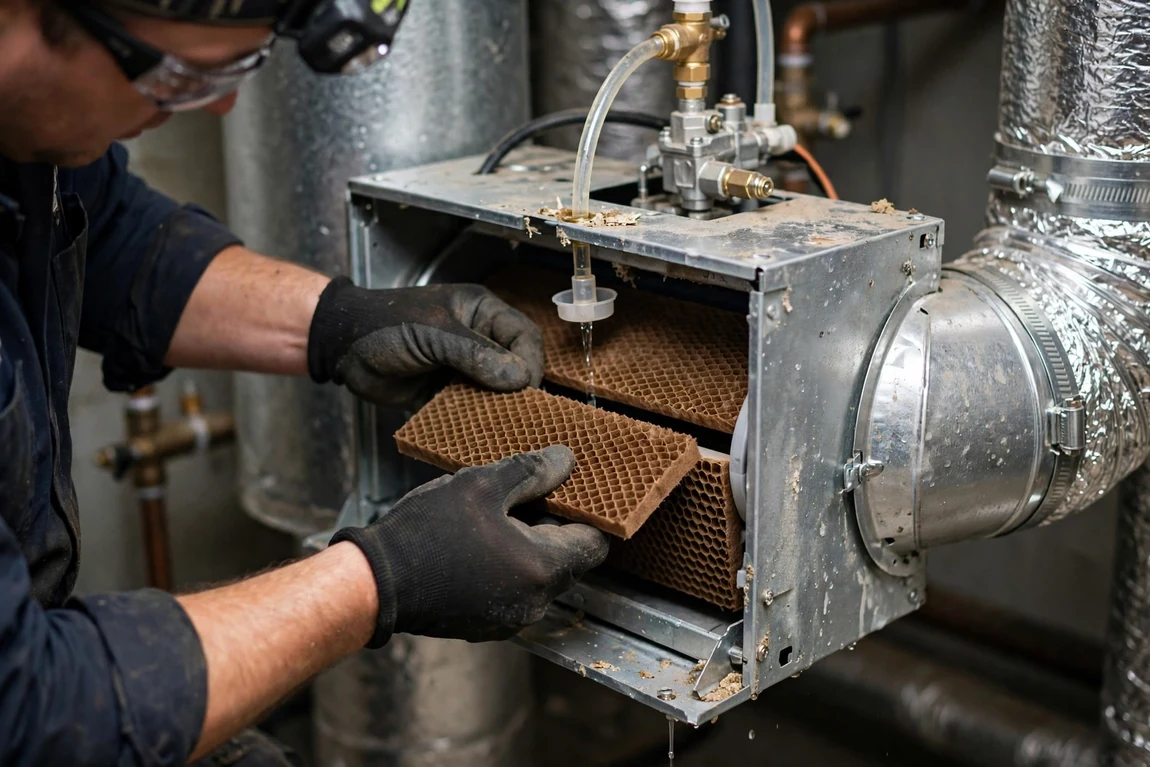
Running costs are low. RealCostIQ estimates about $30 a year in operating costs for a bypass unit, and Angi puts replacement evaporator pads at $10 to $50 per year. Budget for a new pad each heating season and a cleaning to remove mineral scale.

Fan-Powered Humidifiers: More Output, No Bypass Duct
A fan-powered humidifier has its own internal fan. It can push more moisture into the airstream and does not need a bypass duct, which makes it useful where duct space is tight or where higher output is needed without moving to steam.
RealCostIQ puts a fan-powered installation at $500 to $900, with operating costs around $50 a year. Angi places flow-through units, which can be bypass or fan-powered, at $200 to $600 for the unit before installation, so the installed total depends on labor and access.
The fan needs power and adds a moving part. That is a small trade for the extra output, but ask about noise, filter or pad access, and whether the unit can humidify when the furnace is moving air without a full heating call, if that matters for your home.
Fan-powered models are a common middle choice. They cost more than bypass, avoid the electrical demand of steam, and serve larger or leakier homes better than a basic bypass unit that depends entirely on furnace run time.
Steam Humidifiers: Highest Cost and Control
A steam humidifier boils water and introduces steam into the ductwork. It can humidify independently of a heating call and gives the most precise, highest-capacity output. That performance is why it is recommended for large, very dry, or tightly controlled homes.
RealCostIQ puts steam installation at $500 to $2,200. Angi puts steam units themselves at $300 to $1,100 before installation, and its energy data shows why ownership costs differ: steam energy use runs about $150 to $500 a year, compared with only a few dollars for a drum unit and $9 to $28 for flow-through models.
Steam needs more from the house. Expect a dedicated electrical requirement on many models, a water supply, a drain, and canister or maintenance service as the manufacturer directs. Hard water can shorten service intervals, so ask about filtration or water treatment for your area.
Choose steam for capacity and control, not as a default upgrade. If a bypass or fan-powered unit can hold your target humidity in the coldest weeks, steam’s higher energy and service costs may buy performance your home never actually needs.
Labor, Sizing, and Add-Ons
Labor is a large share of a small project. Angi puts labor to install a whole-house humidifier at $100 to $1,000, with HVAC professionals charging $50 to $150 per hour. Some pros also charge a service fee of $100 to $200, which may include the consultation and sizing advice.
Size the unit to the house, not to a guess. Angi notes that capacity is measured in gallons per day, and that a well-sealed 1,500-square-foot home needs about 3.2 gallons per day, while larger homes may need twice that amount. A leaky house loses moisture faster and needs more capacity than a tight house of the same size.
Add-ons are modest but should be counted. Angi puts a hygrometer at $10 to $70, a humidistat at $30 to $150, and replacement evaporative pads at $10 to $50 per year. A good humidistat matters, because over-humidifying can cause window condensation and moisture problems.
Timing can help. If you are already planning duct or furnace work, adding a humidifier during that visit can share the labor and access costs. Our guides to air duct cleaning cost and furnace replacement cost can help you decide whether bundling makes sense.
Running and Maintenance Costs Over Time
Annual professional maintenance typically costs $75 to $200, according to Angi. That visit should include checking the pad or canister, cleaning mineral build-up, confirming the water feed and drain, and verifying that the humidistat reads correctly against a separate hygrometer.
Repairs are usually moderate. Angi puts the national average humidifier repair at around $230, with whole-house ducted units costing as much as $500 to repair. Solenoid valves, fans, and control boards are common repair items as units age.
Do the simple owner tasks on schedule. Replace pads at least once a year, flush or clean parts the manual specifies, and lower the humidity setting as outdoor temperatures fall. That last habit prevents the window condensation that signals too much indoor moisture for the weather.
If dry air is only part of a larger winter problem, pair this project with envelope work. Our guide to winterizing your home covers sealing and preparation steps that also help a humidifier work with less capacity, because a tighter house holds both heat and moisture better.
Frequently Asked Questions
What is the average whole-house humidifier cost?
Angi’s 2026 average is $580, with most homeowners paying $392 to $768. The final whole house humidifier cost depends mainly on type: bypass is cheapest installed, fan-powered sits in the middle, and steam can reach $2,200 installed.
Which type of humidifier is best for my home?
Choose bypass for the lowest cost in a typical well-sealed home, fan-powered for more output without a bypass duct, and steam for large or very dry homes that need precise control. An installer should confirm capacity in gallons per day for your square footage and leakiness.
Can I install a whole-house humidifier myself?
Angi recommends professional installation unless you have extensive HVAC, plumbing, and electrical experience. A poor installation can damage the furnace, void a warranty, or fail to control humidity. Professional labor at $50 to $150 per hour is a small share of the risk it removes.
How much does it cost to run a humidifier each year?
It depends on type. Angi puts yearly energy at $1 to $3 for drum, $9 to $28 for flow-through, and $150 to $500 for steam-powered units. Add pads at $10 to $50 a year and, if you use a pro, maintenance at $75 to $200, so total whole house humidifier cost over time is lowest for bypass models.
What humidity level should I aim for in winter?
Many homeowners aim for a moderate indoor range and then lower the setting as outdoor temperatures drop, to avoid condensation on cold windows. Use a hygrometer rather than guessing, and follow the humidistat manufacturer’s cold-weather chart for your climate and window type.