
It’s late summer, something striped is bullying your barbecue, and the argument starts: is that a yellowjacket or just a wasp? The answer matters more than most people realise. One is a stocky, aggressive colony insect that will sting repeatedly to defend a nest of thousands. The other is a slim garden hunter that would rather be left alone — and is probably eating your garden pests. This guide gives you the ten-second ID for yellowjackets vs wasps, shows you what each one does next, and tells you when a nest near your house is a DIY job and when it’s a professional one.
Yellowjacket vs Wasp at a Glance
| Feature | Yellowjacket | Paper wasp |
|---|---|---|
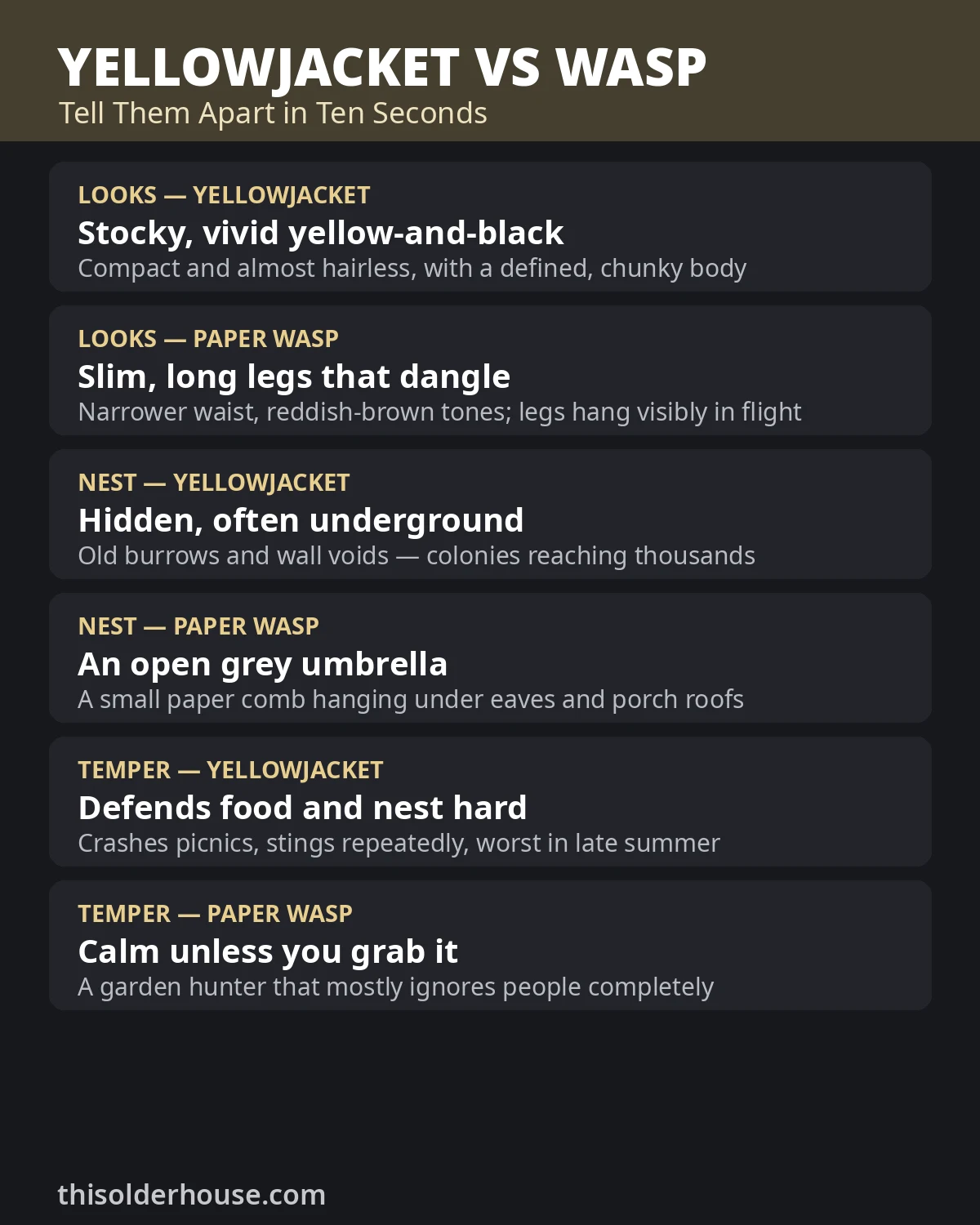
| Body | Stocky, compact, vivid yellow-and-black, almost hairless | Slim with a narrow waist, yellow-brown to reddish, longer body |
| Legs in flight | Tucked up, barely visible | Long legs dangle visibly below the body |
| Nest | Hidden — underground burrows, wall voids, dense shrubs; papery envelope | Open grey paper “umbrella” comb under eaves, fences and porch roofs |
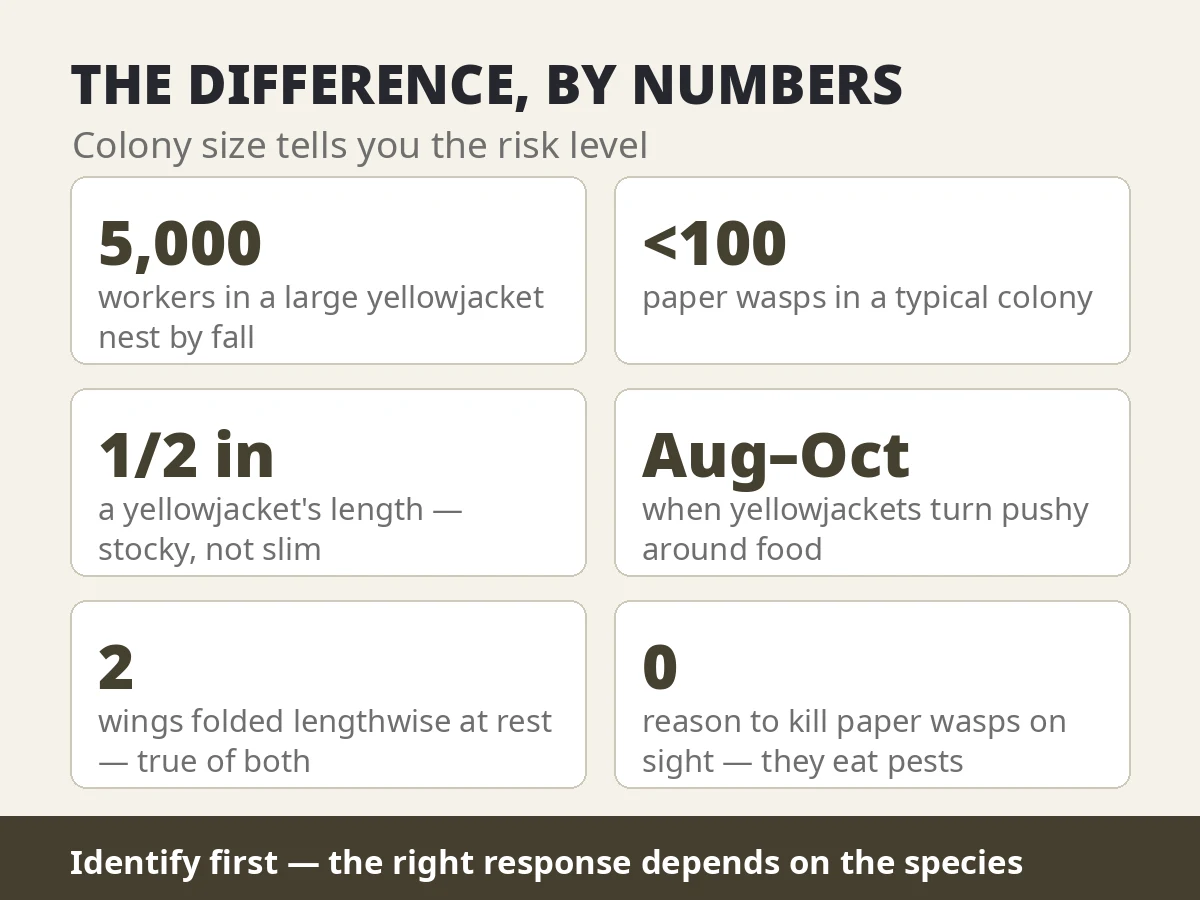
| Colony size | Hundreds to 5,000+ workers by fall | Usually under 100 |
| Temperament | Defensive and food-aggressive, especially August–October | Calm; stings mainly if the nest is touched or it’s grabbed |
| Diet | Other insects, plus your soda, meat and desserts | Caterpillars and garden pests — a genuine garden ally |
The Body Test: Stocky vs Slim
Look at the silhouette first. A yellowjacket is a bruiser: about half an inch long, compact, with bold yellow-and-black bands and a body that looks almost smooth and shiny. A paper wasp is a model by comparison — longer, narrower at the waist, often with reddish-brown mixed into the yellow, and antennae that curve more gently. In flight, the legs settle it: paper wasps let their long back legs dangle below them like landing gear, while yellowjackets tuck theirs up tight. If it’s hovering at your plate trying to steal ham, it’s a yellowjacket — paper wasps have almost no interest in your food.
The Nest Test: Hidden vs Umbrella
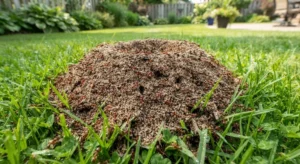
Follow the flight line (from a distance) and the nest confirms the ID. Yellowjackets nest out of sight: in old rodent burrows, hollow walls, dense ground cover — look for a steady stream of insects entering one small hole. Their papery nest is wrapped in a grey envelope and can hold thousands by September. Paper wasps build in the open: a small, grey, umbrella-shaped comb hanging by a single stalk under an eave, a fence rail or a porch light, its hexagonal cells fully visible. A nest you can see the cells of, with a few dozen slim wasps on it, is paper wasps. A hole in the ground with a busy highway of stocky striped insects is yellowjackets — and deserves real respect.
What to Do About Each
Paper wasps: if the nest is somewhere out of the way — a fence corner, a high eave nobody passes — the best move is usually nothing. The colony dies off naturally with the first hard frosts, the nest is never reused, and all summer those wasps are removing caterpillars from your garden for free. If a nest is beside a door or a child’s play area, removal is a small job: our step-by-step wasp removal guide covers timing (after dark, when the colony is home and sluggish) and safety. Small ground-nesting lookalikes that turn out to be bees need a different, gentler approach — see how to get rid of ground bees.
Yellowjackets: a nest far from the house can also be left until frost kills it. But a nest in a wall void, beside a path, or anywhere people and pets pass daily is a genuine hazard — one mower pass over a ground nest can mean dozens of stings. Small, accessible ground nests are sometimes tackled by confident homeowners with a labelled yellowjacket product applied at night; wall-void nests and any nest where someone in the home has a sting allergy are professional jobs, full stop. Never seal a wall-void entrance as your first move: trapped yellowjackets chew through interior walls and emerge inside the house.
Safety Rules for Both
Never swat at a striped insect near a nest — a crushed yellowjacket releases an alarm scent that calls reinforcements. Keep sweet drinks covered outdoors in late summer, and check cans before drinking from them. If a nest must be approached, do it after dark, in smooth light-coloured clothing (dark, fuzzy fabrics read as predators), with an escape route planned. Anyone with a known sting allergy should never be the one to deal with either species — and any sting followed by breathing difficulty, swelling of the lips or tongue, or dizziness is an emergency-services call, not a wait-and-see.
Explore More Pest Control Guides

FAQs: Yellowjackets vs Wasps
Is a yellowjacket a wasp?
Yes — yellowjackets are a type of wasp. “Wasp” is the big family; yellowjackets and paper wasps are two different branches of it, with different bodies, nests and temperaments, which is why telling them apart changes what you should do.
Which is more dangerous, a yellowjacket or a paper wasp?
The yellowjacket, by a clear margin. Both can sting repeatedly, but yellowjackets defend huge colonies aggressively, swarm when disturbed and actively pick fights over food in late summer. Paper wasps sting mainly when their nest is touched.
How can I tell them apart in flight?
Watch the legs. Paper wasps dangle their long back legs visibly as they fly; yellowjackets tuck theirs up. Up close, the yellowjacket is also noticeably stockier and brighter yellow.
Should I remove a paper wasp nest under my eaves?
Only if it’s somewhere people pass closely every day. Out-of-the-way nests are best left alone — the colony dies at the first hard frost, the nest won’t be reused, and the wasps control garden caterpillars all season.
What should I never do with a yellowjacket nest in a wall?
Never seal the entrance hole as a first step. Blocked yellowjackets chew new exits — usually into the rooms of your house. Wall-void nests need a professional treatment that kills the colony in place first.